Thursday, November 9, 2006

AN ARTIST

A few days ago I posted a segment on Stanley Meltzoff's paintings of ancient Greece. I always wanted to meet the artist behind those glorious paintings, but now I never will. As I was posting my blog, Mr. Meltzoff was lying ill in a hospital. Today he passed away.


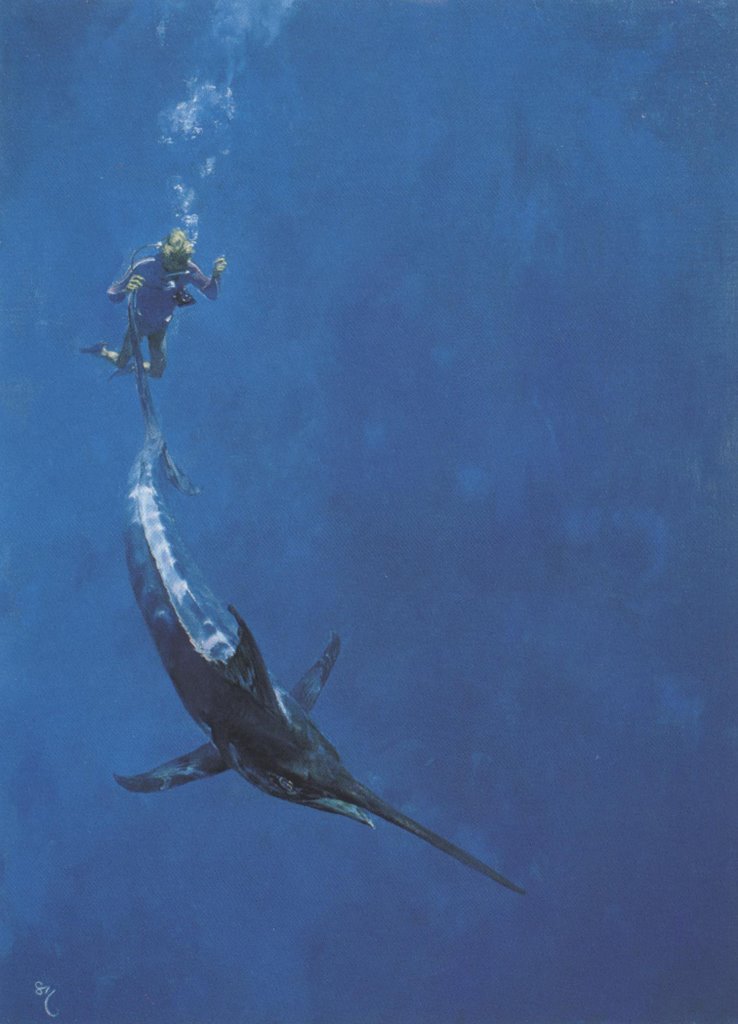
Diver's farewell to Blue Marlin by Stanley Meltzoff


Meltzoff was a gifted author, teacher and artist who painted images from science for Scientific American, historical illustrations for National Geographic and Life, and science fiction covers for a host of publishers.

Like thousands of others, I was enriched by his beautiful work. But I was most inspired by his astonishing intellectual curiosity and his deep artistic purpose. Meltzoff wrote about surviving in the years when the bottom dropped out of the illustration market:
My wife was ill, my children needed college money and I was almost 60 years old. I stood on the corner of 56th and Lexington Avenue in the rain with a soggy portfolio in my hands and improvised a sad little song about defeat, flat feet and flat broke while I tried to think of something to do.
Meltzoff responded to adversity with great artistic potency. He single handedly created a new market for paintings of seascapes and gamefish, which enabled him to combine his expertise in diving with his passion for art. In his spare time he compiled an art reliquarium and wrote a major scholarly treatise, Botticelli, Signorelli and Savanorola, Theologica Poetica from Boccacio to Poliziano. The book is a marvelous work of history, written with great lucidity, insight and humor-- the kind of epic accomplishment that would have capped an entire career for most historians. I recommend it to you.

Please join me in sending thoughts and prayers to Mr. Meltzoff's family. Irene Gallo of the Art Department blog tells me that we can look forward to a book about Meltzoff from publisher Donald Grant books. I will be first in line.

Most people who gamble on earning a living from their creativity have those moments of standing in the rain with a soggy portfolio. William Hazlitt wrote that, "In the end, all that is worth remembering of life is the poetry of it." Whatever else happened in his life, Mr. Meltzoff's gamble paid off royally. One only has to look at his art to know that his life was rich with poetry.


Monday, November 6, 2006


The Thought Project by Simon Hogsberg is very close to the spirit of Sophie Calle, with a slight postsecret twist. Here, too, the idea is simple: ask strangers what they were thinking at the very moment you stopped them. What impresses is the quality of the answers. It seems everyone here is either a writer or a character in a book. That is the impression I have gotten when (rarely) I had the chance to see/read Sophie Calle's work. How can the world be so filled with these amazing characters, these wild thinkers, these witty artistes... Don't get me wrong - not necessarily complex, deep thinkers. But... good people. Ben Harper asks Where'd all the good people go. To the Thought Project.
Then again, Hogsberg interviewed 150 strangers. And on the web page have 55 of them speaking. How was the choice made? In this case, isn't art the sort of science which can allow itself to be subjective, to be flawed, to be partisan? Don't we deserve some hope?

Friday, November 3, 2006

MELTZOFF'S PAINTINGS OF ANCIENT GREECE


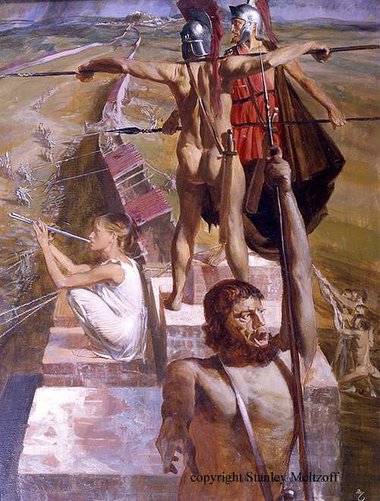
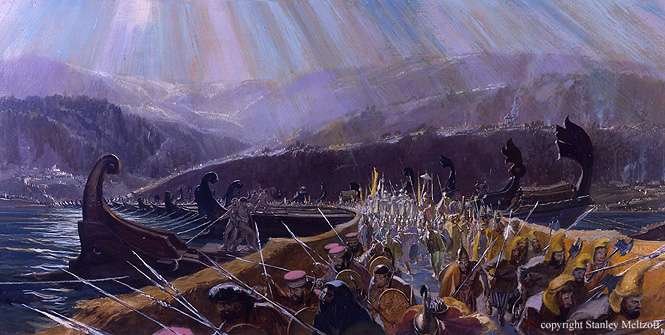
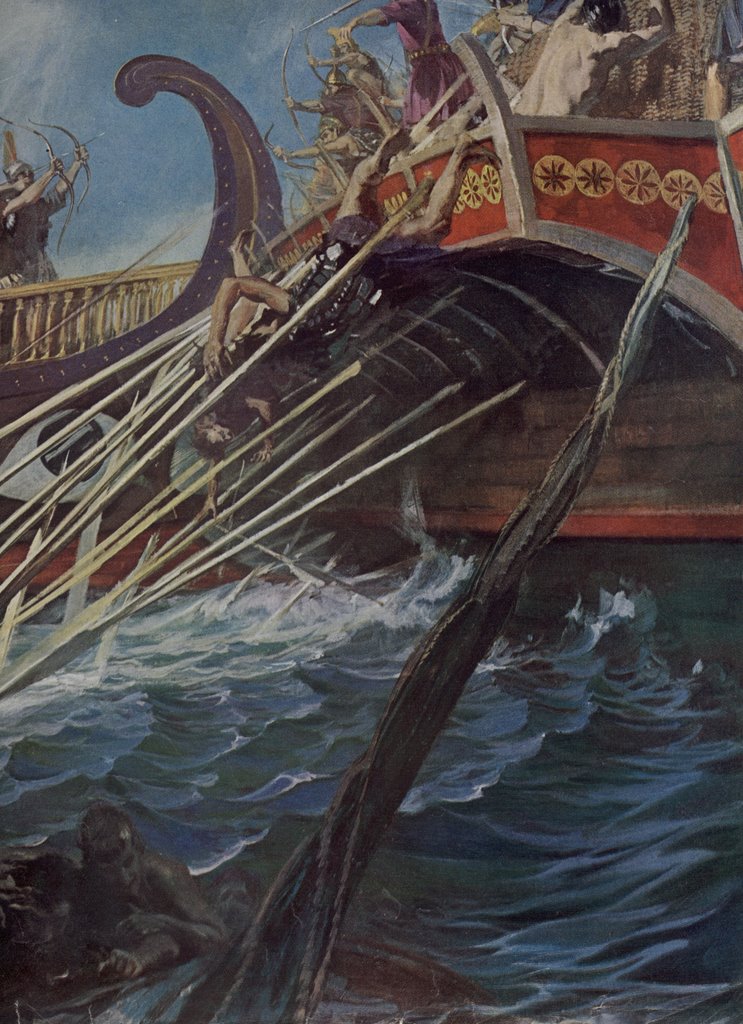
In 1963, Life Magazine commissioned artist Stanley Meltzoff to illustrate an article about ancient Greece. The result was a set of glowing masterpieces that brought ancient Greece vividly to life.


In addition to the beauty of the images, Meltzoff labored long and hard to make his paintings historically accurate. A meticulous craftsman, he even distinguished the uniforms of the Persians from the uniforms of the Scythians and the Medes.

His illustrations conveyed everything from the pathos of an a individual dying in the streets from the plague...


...to the grand sweep of the world's largest army storming across the Hellespont to invade Greece.


These are works of enduring value. They appeared for one brief moment in a 25 cent weekly magazine, then disappeared as Life moved on to a different topic the following week. They aren't displayed in a museum or gallery for the public to admire.


And yet, having appeared once, they are not gone. I can personally attest that these dramatic images were seared permanently into the memories and imaginations of ten year old boys of that time. I am reproducing them here in the hope that there is another generation out there watching.

Wednesday, November 1, 2006

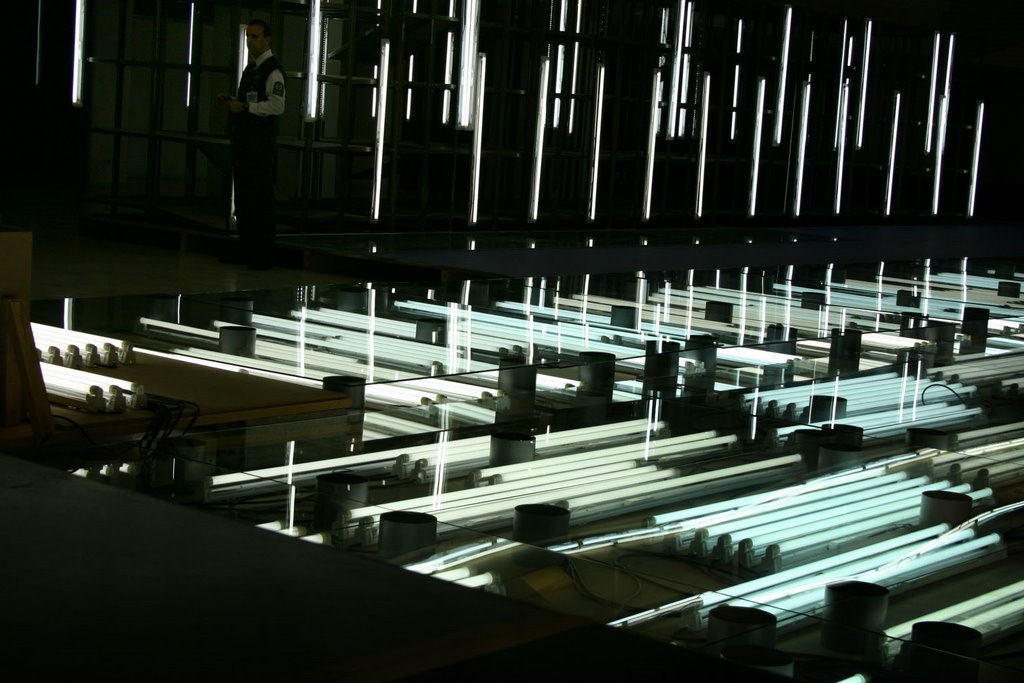
Two more pics of Cabrita Reis + bonus


(part 1 here)

It is constructed. It is not freely distributed. It has a structure. It is the structure it has. The lights have rhythm. The lights are the chaotic order that sustains. They... some are covered with glass. Like a mirror of water. But their transparency doesn't support. Is it protected by those tables? Can we sit on the tables? And what about the guard? Does the guard know he is performing? I suppose so - both him and his colleague try hiding every time I take a picture. What is this light for? What lack of purpose? Who can I ask? Can I ask? Look at this red, look at this brown, look at this gray. Does it ring a bell? Does it ring? And once again: what are we shedding the light on? What foundation? What does it matter? After all, if it is THE FOUNDATION, shouldn't it matter? Those damned neon lights don't even shed the light, they produce it and let it go...
Something apparently useless, apparently stumbling, ending, losing itself, or outdating itself? Then, as long as you persist, as there is another structure, and another, as there is a view, and a point of view, and a work, a body of work, you just find yourself within it,
if you please.

And as a bonus, you get an engraving of an actor in a Japanese opera, from the wonderful exhibition of Japanese engravings, also at the Gulbenkian Foundation, only in the Library building.


ABSTRACT ART: THE CONCLUSION

Art sits back, licking its chops and waiting for the next fool who believes art can be explained rationally.

I've never been that kind of fool. As far as I'm concerned, the quality of art can't be determined by the accuracy of an image or the chemical composition of the pigment. The poet W. H. Auden identified a far more reliable test:

In times of joy, all of us wish we possessed a tail we could wag.
All of this goes to say that my current diversion into the darkest depths of abstract art is not an attempt to find objective criteria for judging abstract art.

However, my personal view is that abstract art and representational illustration-- despite their obvious differences-- both deal at their core with the creation of form, and can both be judged by what
Peter Behrens called "the fundamental principles of all form creating work." These principles enable us to place all visual art on the same continuum. They give us a standard by which even abstract art can be measured. With representational art, we often achieve aesthetic qualities by starting with subjects from nature that embody these qualities, while with good abstract art the challenge is to distill these principles one additional level, to their essence.

Where do aesthetic principles come from, and how do we apply them?

Aesthetic principles such as beauty, balance, harmony and proportion don't simply spring forth on butterfly wings. They are derived from our daily interaction with the world. Our experience of nature is the fundamental starting point from which we come to understand what colors "go" well together, or how we experience effective compositions or which designs elicit certain reactions.


Not only that, but the vocabulary of value in art is the vocabulary of morality. Terms such as "beauty" and "harmony" are terms by which we order our lives as well as our paintings. These words don't offer mathematical certainty. They are subjective and imprecise, but they are central to the most important aspects of our humanity so we agree to tolerate a little ambiguity.

Some of you will object that illustration is very different from abstract or nonrepresentational art at the philosophical / political / biological / metaphysical / sexual / or religious level. Yes, all of those elements may play a role in art, but they are always embodied in aesthetic form. Only the form is essential to art.

Some of you are very irritated that abstract or nonrepresentational art is overrun with talentless pretenders who rushed to fill the vacuum when objective standards departed. This is certainly true. Only recently the New York Times published a favorable review of conceptual artist Sherrie Lansing who practices "appropriation art." Explains the review:

She re-photographed Walker Evans photographs and presented the copies as her own to question what labels like "original" and "classic"' meant, and why they were always applied to men.
To this I can only respond that an artistic theory can't be held responsible for all the clowns who subscribe to it.

Finally, some of you will object that abstract art "cheats" because there is no external point of reference by which to judge the success of the work. Non-representational artists never have to struggle to get that arm right or to solve that problem with perspective. But this only makes the job easier for bad abstract artists. The lack of an external reference point makes it harder for a good artist (and for the audience) to determine when a picture is right.

I think the abstract art that I offered before is "true" applying the standards above. It confidently applies the same kinds of form creating principles that God applied in designing the world, and it gets the images right. It creates visual images that obviously did not come from nature and yet seem organically at home in the world. It is deceptively hard to apply the aesthetic principles described above. For me, 99 percent of abstract art falls far to the left or right of the mark, but when it works, I find it credible and important and valuable.