Wednesday, July 2, 2008

Lucky Stiff Wins BMW Art Car


Brad Carlile gets the "Lucky Stiff" award of the year for winning this beautiful ‘77 BMW 320i art car. It was painted on-site by Tom Cramer at his 2005 show at the Mark Woolley Gallery as part of the DeSoto building opening, Portland’s Museum of Contemporary Craft.

Brad, welcome to world of art cars, your life will never be the same again:)

Monday, June 30, 2008

My Sporelings

Bought the Spore Creature Creator during the weekend, and now i'm totally addicted o.o

Critters i've made so far:
Videos of them in action can be viewed here.

Friday, June 27, 2008

The Phone Car


Photo By Harrod Blank
The Phone Car is also represented by the Art Car Agency

Howard Davis is the creator of the Phone Car a modified a 1975 Volkswagen Beetle. Originally, the car was built to promote his telephone business called Datel Communications. He was featured in Harrod Blank's book Art Cars and recently decided to take time off his job to take phone car on tour to different cities to “put a smile on people’s faces”. Davis car was also recently featured on CBS news, great job and see you at Art Car fest this year.

BORIS CHALIAPIN


In a different country, in another era, Boris Chaliapin (1904-1979) would have been a "fine" artist and portrait painter, selling his paintings in art galleries. The son of Feodor Chaliapin, the great Russian opera singer, Boris was raised in a highly cultured environment. He received classical art training in Russia and Paris. He painted a series of portraits of his father and other luminaries from the world of classical music.


By the 1920s Chaliapin already had a considerable reputation as a portrait artist in Russia. But the market for classical painting was dwindling, and Chaliapin ended up exhibiting his work in the foyer of the London Covent Garden Theatre.


Like most born painters, Chaliapin learned to adapt to reality so that he could continue to create art. Making his way to the United States, he earned a living in New York City following the path of many 20th century artists with technical skill: he became an illustrator, painting more than 400 cover portraits for Time magazine.


Chaliapin is probably my favorite of all the Time Magazine cover illustrators, a sensitive and talented artist. I hope you enjoy his work.

Wednesday, June 25, 2008

The Button King - Art Car Covered in Buttons


Photo By Harrod Blank
Button Hearse is also represented by the Art Car Agency

Dalton Stevens also known as The Button King, got his start as a result of suffering from insomnia. It got really bad in 1983 and he stayed up all night sewing buttons to his denim suit. He finished nearly three years later with 16,333 buttons that weighted 16 pounds. He then went on to glue 3,005 buttons to his guitar, 517 buttons to his shoes. He also covered a Hearse, a Chevrolet Chevette, a casket and a toilet as seen in the picture. He also wrote Insomniac Shuffle and Poppin' Buttons and recently opened The Button King museum for anyone interested in seeing his complete button covered works.
For more detailed bio and photos see link

Monday, June 23, 2008

Art Car Covered in Dentures - ChewBaru

Art Car Covered in Dentures - ChewBaru
More photos link

This 1995 Subaru called "ChewBaru" is covered in approximately 70 pounds of dentures, 60 pounds of dental impressions, photos and illustrations from old dental school books, empty toothpaste tubes, and other items related to dentistry. It was created by artist and motorcycle rider Rex Rosenberg from Kansas. This car reminded me when my grandfather would pop his dentures in and out of his mouth during dinner just to gross mom out. That and all the other cool things he showed me, is what made him my favorite grandfathers. Thanks Rex for bringing back all those good times to mind:)
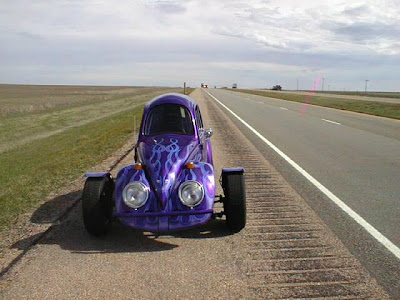
VW BugWing Art Car
He is also the creator of the "BugWing" art bike, a VW shell cut in half, mounted on a 1981 Gold Wing and turned into a three wheeled vehicle.
For the complete story see link.

Saturday, June 21, 2008

LUNATICS AND BUREAUCRATS


In 1985, Rembrandt's "Danae"-- surely one of the most beautiful paintings in the history of the world-- was attacked by a man who slashed the painting with a knife, then doused it with sulfuric acid.


As the New York Times reported, the acid turned Rembrandt's lovely colors into a "dark, bubbling, foul-smelling mass that trickled down to the bottom of the the frame and from there onto the floor."

In 1972, an unemployed geologist attacked Michelangelo's Pieta with a hammer, crying, "I am Jesus Christ — risen from the dead!" He knocked off the Virgin's arm at the elbow, broke off a chunk of her nose, and chipped her face.


Then there was the man who walked into an Amsterdam museum and repeatedly slashed a masterpiece by the painter Barnett Newman. The man spent 5 months in jail for his crime, then returned to the same museum and slashed another painting by the same artist worth about $12 million.

And let's not forget the time in 1975, when a former mental patient claimed that he had been ordered by God to attack Rembrandt's magnificent "Night Watch."


He slashed and hacked the 14-by-11 foot painting more than a dozen times, tearing out a chunk of canvas over a foot long.

It is hard to explain such savage attacks on beautiful objects. If you have trouble putting yourself in the mind of someone who behaves that way, you should be very glad. The people who do such things lead hellish lives untouched by beauty or pity.

But before you get too comfortable on the "sane" side of the dividing line, consider this: in 1715, the town fathers of Amsterdam decided to install that very same painting, Rembrandt's Night Watch, in their Town Hall. They picked the perfect spot between two columns. Unfortunately the painting was too large so they cut off sections of the painting on all four sides, to make it fit. They removed two figures on the left side of the painting as well as the top of the arch, the balustrade, and the edge of the step. This was not the spontaneous outburst of a lunatic, this was a bunch of civil servants acting with the best intentions. There is no record that the town officials were ever confined to a mental institution. But again-- if you have trouble putting yourself in the mind of someone who behaves that way, you should be glad.

The Buddhas of Bamyan were two monumental statues of Buddha carved into the face of a cliff in Afghanistan nearly 2,000 years ago. The statues were immense-- almost 180 feet high.


In 2000, the Afghan government (at that time, led by Supreme Commander of the Taliban Mullah Mohammad Omar) ordered that these ancient treasures be destroyed to avoid idol worship. Again, this was no impetuous act. It was calmly discussed by a number of government officials who, in the end, systematically dynamited these masterpieces. Taliban Minister of Information and Culture Qudratullah Jamal issued bland progress reports to the press: "The work started about five hours ago but I do not know how much of [the Buddhas] has been destroyed." Is there a lunatic out there who can match the work of bureaucrats steadily going about their business?

Finally. we come to the case of the Lascaux cave, probably the single greatest treasure trove of paleolithic art on the face of the earth.


Lascaux contains about 600 paintings and 1,500 drawings that have survived for approximately 17,000 years. Since the cave was discovered in 1940, thousands of people from around the world have been awed by its beauty.


In 1999, the French bureaucrats who administer the cave decided to install a new air conditioning system. By most accounts, it was a disaster. They selected a local contractor with no experience with caves. The workers were left unsupervised and ignored the pleas of the curators, tracking pollen in and out of the cave, leaving the door open, and piling up construction waste on the site. As Archaeology Magazine reported:
It is hardly surprising that by 2000, as soon as the work was completed... biological pollution appeared. Within a month a fungus, fusarium solani, characterized by white filaments, was growing on the cave walls.... Powdered quicklime was scattered on the floor to sterilize the cave, but this raised the temperature, further destabilizing the interior climate.... The new installation involved removing the roof from the chamber at the cave entrance.... exposing the cave to the impact of outside temperature variations. Consequently, water runs down the cave walls (and paintings) at times, followed by periods of extreme dryness.
If the French officials had been willing to admit their mistake, perhaps more could have been done to protect the art. However, as conditions in the cave deteriorated, the squabbling bureaucrats covered up their problems, barring scientific experts and cultural observers from inspecting the problem. Time magazine reported with frustration, "Nobody claims authorship of the decision to install the new machine."


Spores growing on prehistoric painting

The deplorable conditions at Lascaux were brought to the attention of the world by a valiant and determined woman named Laurence Beasley, who founded the International Committee for the Preservation of Lascaux. She refused to be intimidated by the bureaucrats, and went all the way to UNESCO for help in rescuing the cave. As Archaeology Magazine reported,

In spite of the authorities' reluctance to admit their responsibility for today's crisis, and the way they have downplayed the seriousness of Lascaux's position, the ICPL has succeeded in exposing the cave's dire condition and alerting the public.... A spokesperson for the ministry of culture has repeatedly denied that there is damage to, or fungi on, the paintings, despite clear photographic and eyewitness evidence. At one point the ministry of culture claimed the fungi have "disappeared naturally," yet restorers were still working in the caves three days a week, manually removing the fungi by their roots-- extractions that have left dark marks and circles on the paintings. Clearly the public has not been told the truth.
I commend to you the important work of Laurence and her nonprofit organization. Visit her web site. Read about Lascaux and sign her petition. Make a contribution if you feel like it. (Full disclosure: as a lawyer, I do pro bono work for the ICPL because I believe in their cause but as always, I am solely responsible for the opinions on this blog.)

Gentle and beautiful objects have many natural enemies in this world. I don't know whether the greater threat to art comes from lunatics with knives and acid, or from cold bureaucrats and civil servants protecting their turf and hiding their incompetence.