Thursday, November 3, 2011

EMPTY ARMS


You hardly ever see pictures of men carrying women in their arms these days, but once upon a time such pictures made up 71.32% of all illustrations in women's magazines.

 John Gannam

Readers of Redbook, Good Housekeeping, Ladies Home Journal, Cosmopolitan and McCall's all seemed to love these pictures.


Then, sometime around the middle of the 20th century, such illustrations became extinct.  Why?

Leonard Starr

Apparently, women realized they could travel faster, and usually in a better direction, by walking on their own two feet.

Of course, there could be other explanations (besides transportation logistics) for why these illustrations were so popular with women.  If you accompany a man to the cave of the winds, being carried gives you deniability about your assent.  In a subtler era, this ambiguity could play a significant role in your relationship with the man, or with your mother.  In the second half of the 20th century, ambiguity would become less important.

Or perhaps these illustrations began to lose their charm as women looked at this same theme in men's magazine illustrations, and realized what had been going on in the heads of the lummoxes who had been carrying them:

Norman Saunders
Regardless of physical strength, women often end up doing the heavy lifting.

If you look at some of the old illustrations of men carrying women, you see that (politics aside) there was room for a lot of play and psychology and communication as a result of the fact that nature had endowed one sex with the physical strength to lift the other.

But whatever the reason, those nuances are no longer of much interest, so neither are the illustrations.

The end of the demand for such pictures (rather than the invention of photography or television) may be the real reason for the shrinkage of the illustration market.

Tuesday, November 1, 2011

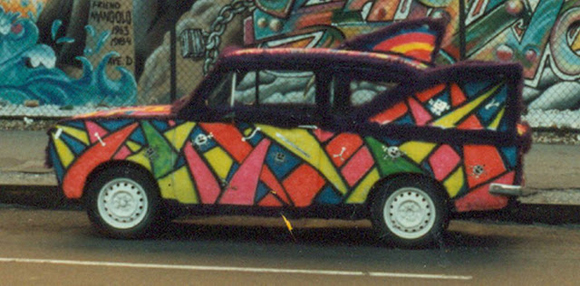
30 Hoop Art Cars of Extreme Awesomeness

COMMUNICATIONS CAR art car
Hoop COMMUNICATIONS CAR art car
Hoop was one of the most colorful and prolific art cartist ever and his passing last September will leave a big giant hole in the art car world. His real name was Stephen Douglas Hooper was a New Jersey-based sculptor was often seen riding his hoop creations around east village and beyond were he became well known. There are simply not enough words to describe Hoop and his amazing art cars, so I figure 30 of his art car creations should do the trick. Hoop definitely falls under the "Extreme Awesomeness" category, so may he and his art cars live in eternal Awesomeness here on art car central for eternity or until the internet crashes and burns.
Artist LISA INGRAM with Hoop 1941 PACKARD
Artist LISA INGRAM with Hoop 1941 PACKARD "LUXURY LIMO"
HOOPMOBILE
HOOPMOBILE "LIBERACE EDITION"
Actress PENELOPE PALMER and the METROPOLITAN HOOPMOBILE
Hoop Head Photo by George Bonanno

HOOP as "THE KING OF ART" & THE ROYAL HOOPMOBILE

HOOPARAMA Art Van

Hoop RECORD RIDE art van

SODA
Hoop  SODA POP ART LAWNMOWER Art Car

Hoop TIME MACHINE 2002 Art Van
Hoop Hoop TIME MACHINE 2002 Art Van

Hoop I said Art Van

Hoop TIME MACHINE 2000 Art Van
Hoop Hoop TIME MACHINE 2000 Art Van

HI TEK HOOP Art Van
HI TEK HOOP Art Van

Hoop Can Van
Hoop Can Van

CAR OF THE FUTURE art car
Hoop CAR OF THE FUTURE art car

Hoop CANVERTIBLE art car

Heli_hoop art car title=
Heli_hoop art car

Hoop Spin Art Van
Hoop Spin Art Van

Hoop Hoop CUTTING EDGE LAWNMOWER art lawnmower

Hoop GOOD LUCK TRUCKart truck

SUPERHERO HOOP art van

Hoop Hoop MUSICMOBILE

HOOP SPHINX art van
HOOP SPHINX art van

Hoop MATCHBOXMOBILE
Hoop MATCHBOXMOBILE

Hoop Time Capsule art van

Hoop HOTWHEELS art car
Hoop  HOTWHEELS art car

Hoop MOSAICMOBILE art car

VOODOO VOLKSWAGEN & HOOP WITH SELF PORTRAIT

EXTREME HOOP art car

Hoop FINNED FIAT art car

Photos via

Monday, October 31, 2011

The Political Sight - Konrad Pustoła's 'Views of Power'


What do you see?

This, here, is an image of power.
Pure and simple, it is what a specific person with power sees. Out of the window. Every day.
Some of the Views of Power, a project by Konrad Pustoła, could be postcards. They are annoyingly nice. Others - most of them, actually -  seem violent in their chaotic setting.
And so, the game begins - can you match the picture to the person? Does it tell you something more about who the person is? Or is it vice versa - the person informs your view of what this view is?

After taking the pictures, Pustoła posted them on billboards in every possible corner of the city.
No, it's not about the contrasts. It's not about looking for contrast. Rather, it is about asking yourself, what is this power? What does this view have? Do I want something from it? What could I possibly want - and expect - from this? Each context is a confrontation of one view with another. It shows the complex web of relations that go beyond a simple decision-making process. For it is clear, here, that we are part of this world of power to a much greater extent than we might think. We co-define it. Which makes it less surprizing to discover the familiarity of some of these views.

One of the most exciting aspects of this project is perhaps the most obvious one - why this window? What is this person's power? It's like trying to discover what are the superpowers of some superhero - only here, there is no super. The power is quite real. It can be power over the soul, the body, the political body. But we can name it, one way or another. And through this simple choice, of deciding this is a person with power, Pustoła provokes us, saying, look, I've made my choices, those are the views I associate with power, here and now, where are yours?

The accent on our capacity to choose power comes across even in the formal approach: these pictures are not attempting to be particularly nice, or ugly. They aren't shot as panoramas, which could seem an obvious solution. But a wrong one. It would suggest that the picture sees it all - that there is, indeed, a panorama. The "standard" angle is a political choice. It tells us clearly, this is the view. The limits are part of this game. They provoke us, ask for alternatives, answers, consequences other than the ones we already have. The billboards set the record straight: if power is always symbolic, the symbol requires context more than scope. The choice, and hence the power, is sharp as a small and precise frame.

There is one more aspect of this simple and effective work.
It was made locally. I was told the plan is to have the scope broadened. I like it as it is. It was made in one Polish city - Krakow. It is the third largest Polish city. Not the capital. Not the center. Neither the periphery. It is one place in the world. And a few windows. Where's the power? In the view, of course.
The views, in order of appearance, belong (?) to: Wisława Szymborska (poet and Nobel Prize Laureate), Magdalena Sroka (v-ce President of Krakow), Jerzy Meysztowicz (businessman), Andrzej Wajda (film director), and, below two of the pictures on billboards, cardinal Stanisław Dziwisz.

Sunday, October 23, 2011

Still Life: Cup of Joe and French Press


Cup of Joe, 22" x 28" acrylic on canvas panel and French Press, 28" x 22" acrylic on canvas panel.

Eastern WA Landscapes

Chief Joseph Road WA and Chief Joseph Creek at Grand Ronde WA

Both - 22" x 28" acrylic on canvas panel

Paintings inspired by the the photography of Craig Robinson.

Friday, October 21, 2011

0NE LOVELY DRAWING, part 38

This woodcut by Lynd Ward scared the crap out of me when I was a boy:


Ward (1905-1985) became known in the 1930s for his "wordless novels" comprised entirely of woodcuts.  (His first, Gods' Man, a powerful story about the corrupting influence of money, debuted the week of the great stockmarket crash in 1929).

I discovered a battered collection of Ward's books on my father's bookshelf.  This illustration-- one of my favorites-- was from Mary Shelley's Frankenstein.

At age five, I was already expert at drawing scary monsters.  I'd figured out that the two most important ingredients for a monster were 1.) a scary face, and 2.) great big muscles.  Yet, Ward's monster had neither.  Ward succeeded in unnerving me without showing a face at all. 


That gave me plenty of food for thought.

Today you see artists straining to draw scarier faces and bigger muscles.  They'd do well to linger for a moment over the work of Lynd Ward.