Contact for info: michele.deadred (at) gmail.com
[updated February 2011]
If you have emailed me regarding possible commissions during this month (February) or earlier, I will still be available for work at the timeframe I have previously mentioned. I'm currently really busy until March. I'm always available for discussing commissions for a later date, of course :)
If any studio is hiring, I'm interested in full-time on-site work.
I'm a quiet and hardworking little geeky girl. I draw real nice, learn new skills fast, and I'd like to think I have a great sense of humor (penis jokes count, right?). I'm also able to move anywhere: I have no pets, no babies and no addictions.. well except for coffee :P If I can get caffeinated at your studio, I'm good to go!
Sunday, December 31, 2006

Saturday, December 30, 2006
ONE LOVELY DRAWING, part nine
There is obviously no such thing as the single greatest drawing in the history of the world. It would be foolish to think about rating art that way.
However, if there was such a drawing...
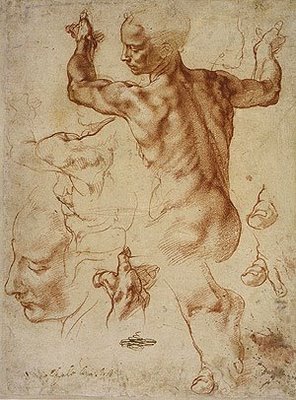
...it would probably be this one by Michelangelo. It is a preparatory drawing for Michelangelo's illustrations of the Bible for the Sistine Chapel.

I can't think of any object with more grace or beauty with which to end 2006.
This drawing is of the Libyan Sibyl who foretold "the coming of the day when that which is hidden shall be revealed." She had the power of prophecy because she was by birth half mortal and half divine: "An immortal nymph was my mother, my father an eater of corn."
I am just a lowly corn eater myself but I have enjoyed sharing these lovely images with you in 2006 and I wish all of you the happiest of new years.
However, if there was such a drawing...

...it would probably be this one by Michelangelo. It is a preparatory drawing for Michelangelo's illustrations of the Bible for the Sistine Chapel.
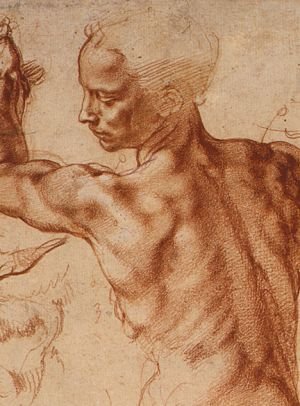
I can't think of any object with more grace or beauty with which to end 2006.
This drawing is of the Libyan Sibyl who foretold "the coming of the day when that which is hidden shall be revealed." She had the power of prophecy because she was by birth half mortal and half divine: "An immortal nymph was my mother, my father an eater of corn."
I am just a lowly corn eater myself but I have enjoyed sharing these lovely images with you in 2006 and I wish all of you the happiest of new years.
Sunday, December 24, 2006
ADVICE FROM ARTISTS
I generally sympathize with Matisse's view that artists should cut their tongues out so they won't be tempted to explain their work. It may not show, but I do try on this blog to avoid adding to the sum total of BS written about art in the world.
Here are some comments about the artistic process from illustrators or other artists that I think are particularly insightful:
Don't stop to admire a partly completed sketch.
--Robert Fawcett
On always doing your best work: The argument that "it won't be appreciated anyway" may be true, but in the end this attitude does infinitely more harm to the artist than to his client.
--Robert Fawcett
On being accused of making art like a madman: There is only one difference between a madman and me. I'm not mad
--Salvador Dali
What one has most to strive for is to do the work with a great amount of labor and study in such a way that it may appear, however much it was labored, to have been done almost quickly and almost without any labor, and very easily, although it was not.
--Michelangelo
I ain't yet worked out whether I like girls because I like curvy lines or if I like curvy lines because I like girls.
-- some artist on the internet whose name I forgot to write down
On when to put the finishing touches on an illustration: The longer the idea can be considered in the abstract, the better.
--Robert Fawcett
There are moments when art attains almost to the dignity of manual labor.
-- Oscar Wilde
Here are some comments about the artistic process from illustrators or other artists that I think are particularly insightful:
Don't stop to admire a partly completed sketch.
--Robert Fawcett
On always doing your best work: The argument that "it won't be appreciated anyway" may be true, but in the end this attitude does infinitely more harm to the artist than to his client.
--Robert Fawcett
On being accused of making art like a madman: There is only one difference between a madman and me. I'm not mad
--Salvador Dali
What one has most to strive for is to do the work with a great amount of labor and study in such a way that it may appear, however much it was labored, to have been done almost quickly and almost without any labor, and very easily, although it was not.
--Michelangelo
I ain't yet worked out whether I like girls because I like curvy lines or if I like curvy lines because I like girls.
-- some artist on the internet whose name I forgot to write down
On when to put the finishing touches on an illustration: The longer the idea can be considered in the abstract, the better.
--Robert Fawcett
There are moments when art attains almost to the dignity of manual labor.
-- Oscar Wilde
Saturday, December 2, 2006
A FEW SMART DRAWINGS
The illustrator Fred Ludekens said "drawing is thinking." Here are some wonderful examples of what makes visual thinking better than verbal thinking:
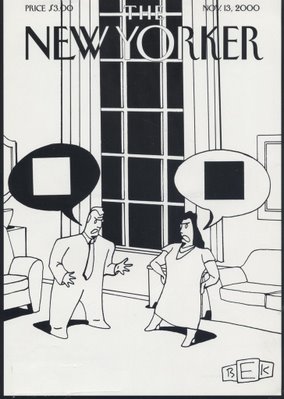
copyright The New Yorker
Images can convey complex thoughts with more immediacy, universality and ambiguity than words can offer.
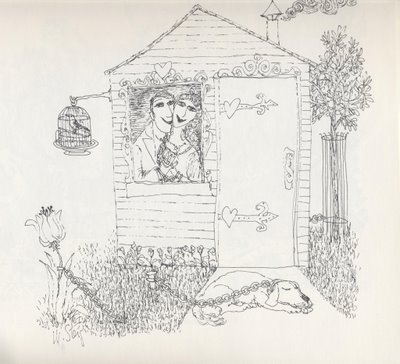
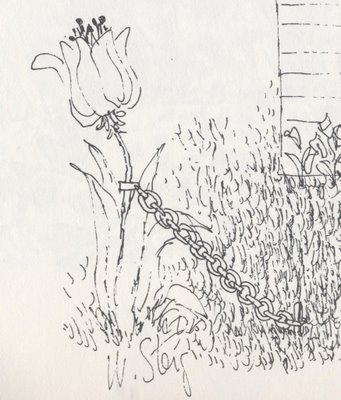
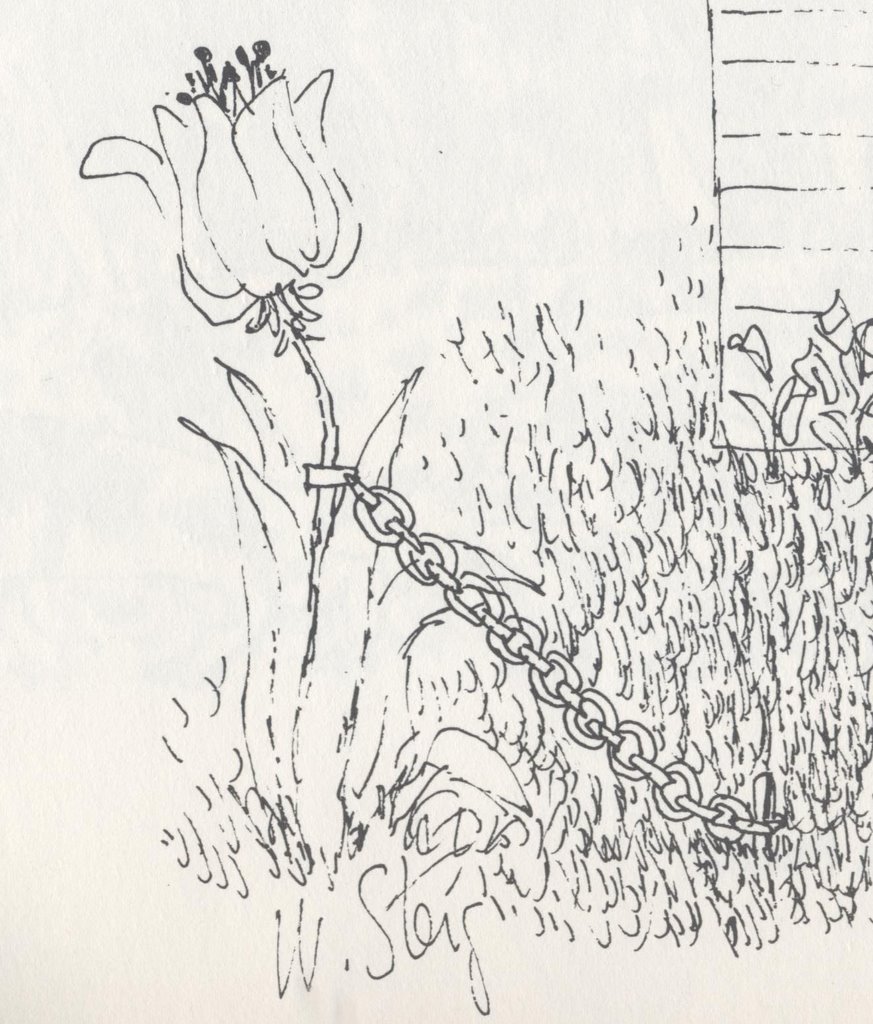
For example, William Steig's drawing above of the blissful young lovers in the cottage makes a wicked statement about the darker, proprietary side of bliss by chaining the flower in the front yard:
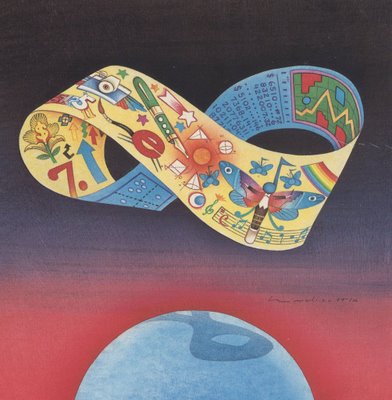
As another example, the Foote Cone & Belding drawing below shows that creativity and logic are two sides of the same phenomenon by placing them on opposite sides of a moebius strip-- which only has one side.
copyright Foote, Cone & Belding
Next, the symbols chosen by the brilliant Saul Steinberg-- Uncle Sam facing off against a fatted Thanksgiving turkey in the bull ring, presided over by the statue of liberty and Santa Claus-- juxtapose categories rich with meaning in ways that words with definitions just can't.

copyright The Saul Steinberg Foundation/Artists Rights Society (ARS), NY
How many sentences would it take to explain such thoughts in words? Good visual ideas dance where words cannot go. More importantly, how many related ideas would you miss along the way if you were led to a conclusion by linear sentences, rather than by rolling these images around in your mind?
Some sequential artists and graphic novelists seem to think that intelligent drawings are merely drawings accompanied by word balloons containing intelligent words. For me, this view surrenders the real strength and potency of the visual medium.

copyright The New Yorker
Images can convey complex thoughts with more immediacy, universality and ambiguity than words can offer.
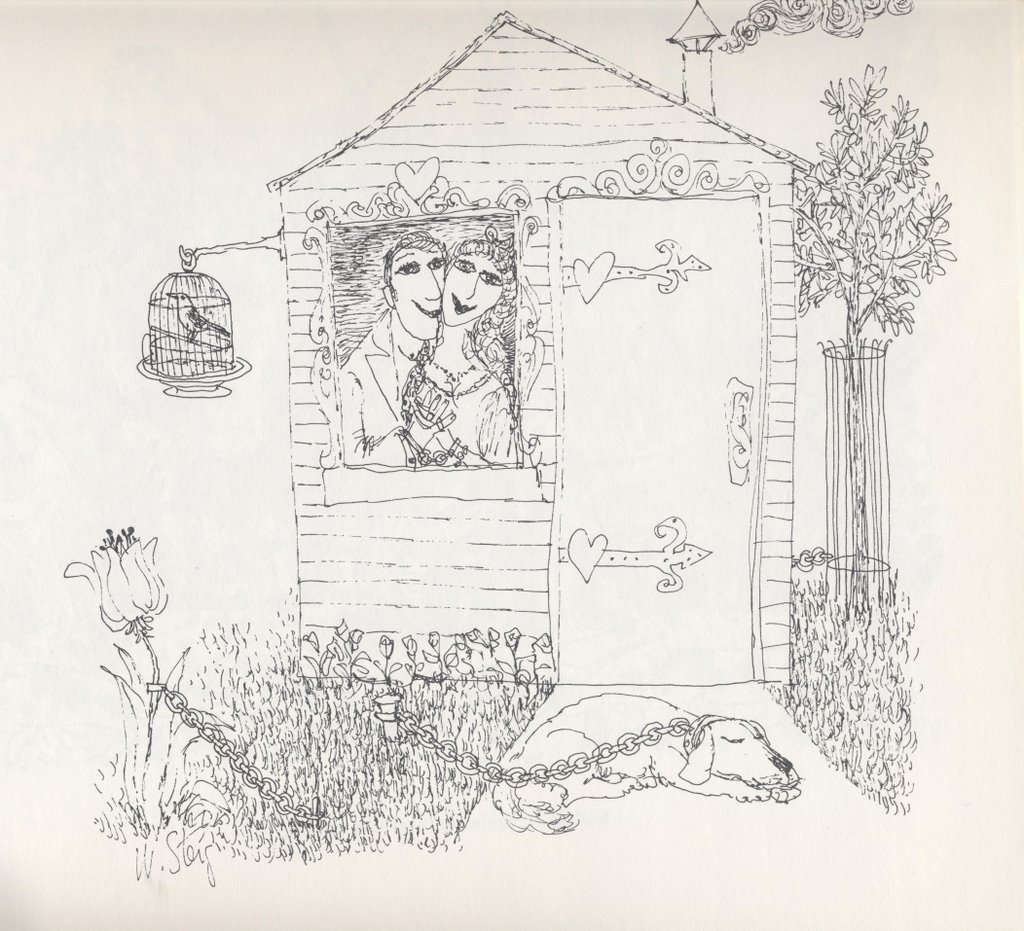
For example, William Steig's drawing above of the blissful young lovers in the cottage makes a wicked statement about the darker, proprietary side of bliss by chaining the flower in the front yard:
As another example, the Foote Cone & Belding drawing below shows that creativity and logic are two sides of the same phenomenon by placing them on opposite sides of a moebius strip-- which only has one side.
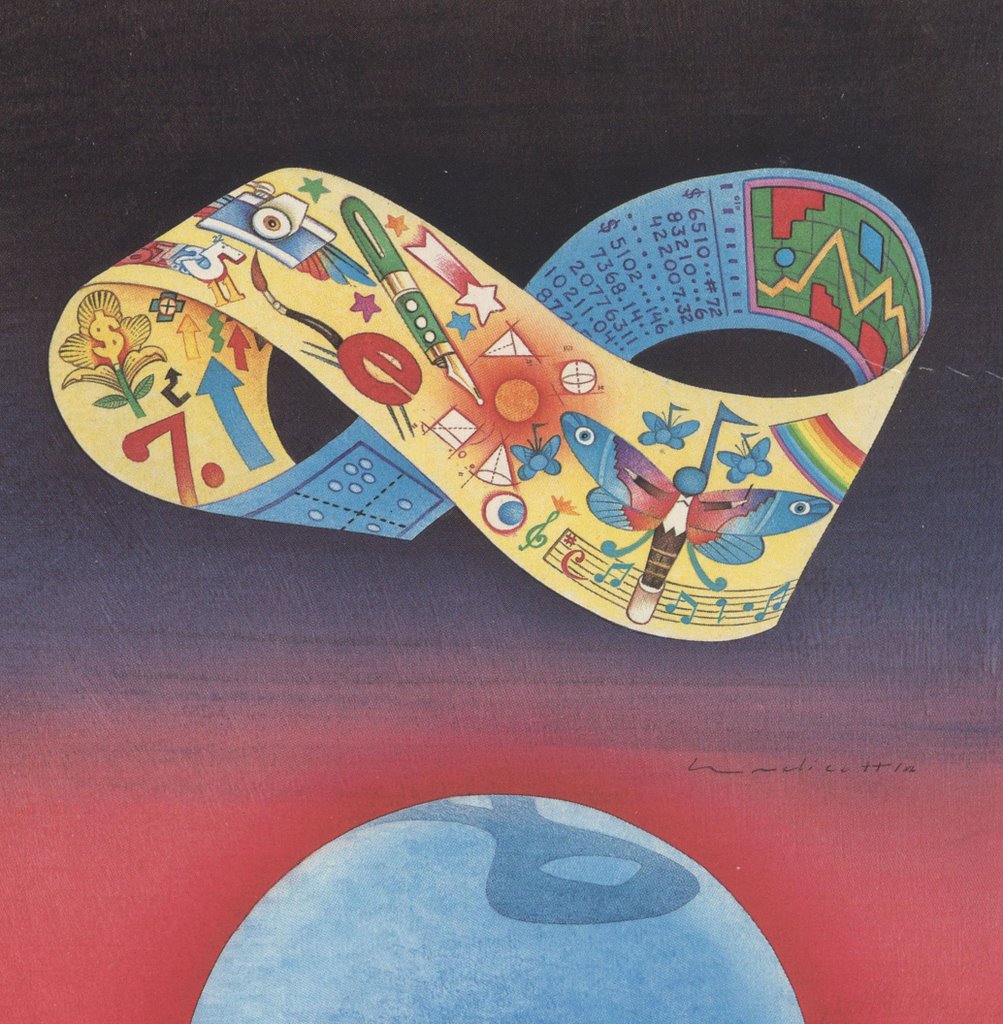
copyright Foote, Cone & Belding
Next, the symbols chosen by the brilliant Saul Steinberg-- Uncle Sam facing off against a fatted Thanksgiving turkey in the bull ring, presided over by the statue of liberty and Santa Claus-- juxtapose categories rich with meaning in ways that words with definitions just can't.
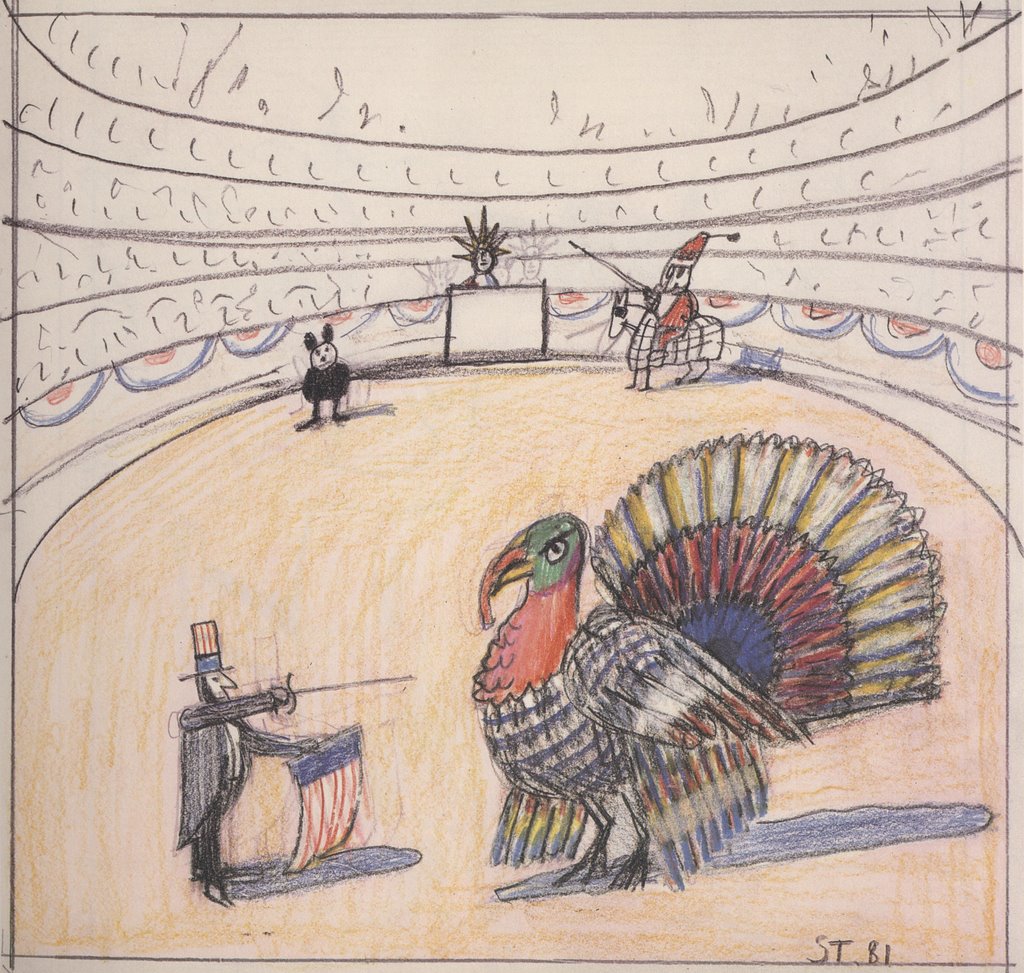
copyright The Saul Steinberg Foundation/Artists Rights Society (ARS), NY
How many sentences would it take to explain such thoughts in words? Good visual ideas dance where words cannot go. More importantly, how many related ideas would you miss along the way if you were led to a conclusion by linear sentences, rather than by rolling these images around in your mind?
Some sequential artists and graphic novelists seem to think that intelligent drawings are merely drawings accompanied by word balloons containing intelligent words. For me, this view surrenders the real strength and potency of the visual medium.
Monday, November 27, 2006
Between us (and the body). Shen Wei

A Chinese photographer moves to the U.S. Here, he discovers bodies. Bodies as social places. Bodies as identifiers, as the places of definition. How does the place one belongs to relate to the body one owns (isn't this a beautiful expression? to own a body...)?
Shen Wei's series Almost Naked is a guided tour of identity caught in body. Or of the body as caught up in identity. Whichever way you put it, there is a feeling of self, that is, that the pictures are not of the person's body, but of a person as she reveals/hides herself. There is a certain foreigner's curiosity of how the others deal with who they are, what they are, and what they can present to someone else. This curiosity, and the way the subjects deal with it, is one of the most delightful aspects of Wei's work.
 There is sometimes a feeling of a dangerous zone, of a fragile state that almost makes one look away, as if there was something indecent about showing oneself. As if it were an exposition and not a capturing of something. Then again, curiosity is stronger and I dare you not to look at all the pictures with great attention. The attraction of intimacy, combined with a gentle sense of humor, is right on the spot. Shen Wei says:
Once I achieve the trust of the model, I can feel their energy and their desire to be seen and be explored but at the same time still reserve some for themselves. It is in those Almost Naked moments that my subjects are the most exquisite, when things occur, and what generally is not displayed initially in public is exposed. I emotionally and physically strip the sitters when the trust and friendship is built between us. The key to building that trust and friendship is to make them feel at ease with conversation and personalized emotion contact. It can sometimes be psychological, sometimes more sensual, sometimes more or less sincere, depending upon the personality of the sitters and the intimate level of the environment. It is the art of psychology within making art.
 None of the people smile.
I found this through the placebokatz blog, which to my great joy (as always when that happens) has put a link to this humble page.
Sunday, November 26, 2006
ARTISTS IN LOVE, part six

The illustrator Rockwell Kent (1882 - 1971) loved humanity with great passion. Unfortunately, he was an utter jerk when it came to loving individual human beings.
Kent was famous for his illustrations for Moby Dick, Candide, Shakespeare and Chaucer. He was also the author of several acclaimed books, an explorer, an architect, a dairy farmer, a carpenter, a fisherman, a sailor and an outspoken advocate of socialism who was awarded the Lenin Peace Prize by the Soviet Union for his work to achieve peace and brotherhood.
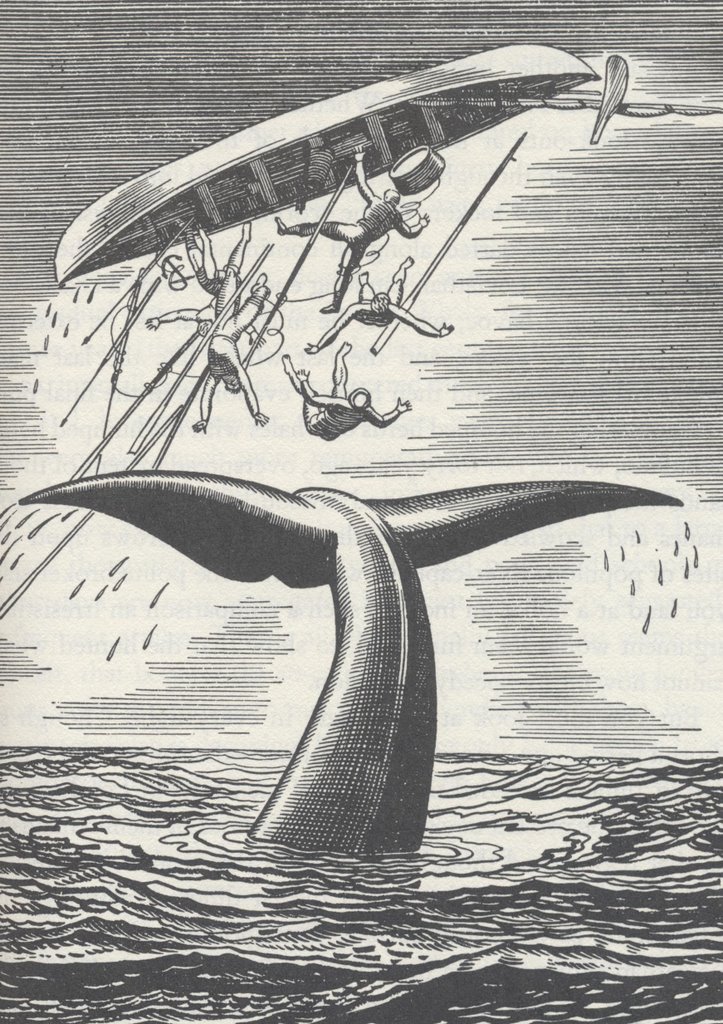
Kent had many wild adventures around the world. He hiked through jungles and over mountains. He explored islands and traveled on freighter ships. Once he attempted to sail around Cape Horn (at the southern tip of South America) in a ramshackle life boat that he bought for a few dollars. Wrote one commentator:
This region, boasting probably the world's worst climate, is buffeted incessantly by winds, swiftly alternating with rain, hail and snow. It is the legendary graveyard of ships and sailors, and Kent [had] the half-formed idea of trying his mettle against the hazardous adventure of sailing "round the Horn."He was shipwrecked in Greenland and Alaska and lived for extended periods of time north of the Arctic Circle in desolate places like Ubekendt Ejland (Unknown Island). But his first love was painting and he painted almost every day.
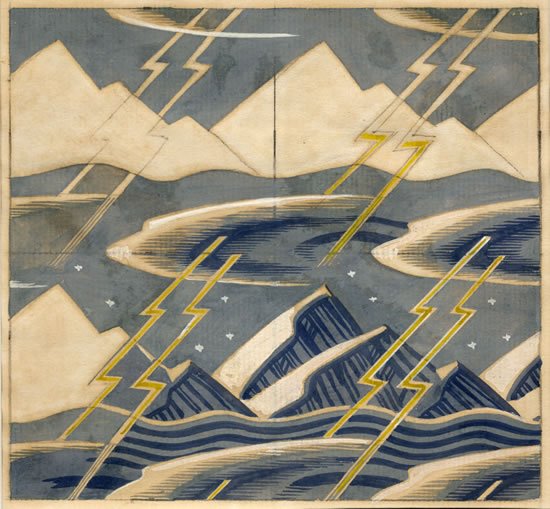
Kent's artistic mentor was the painter Abbott Thayer. While living as a guest in Thayer's house, Kent married Thayer's 17 year old niece over the objection of her family. Four months after the wedding, he resumed a love affair with an old flame. Kent went on to have torrid affairs with a variety of girlfriends while his devoted wife stayed at home and bore him five children. (When one of his girlfriends became pregnant, Kent and his wife had to sell everything they owned to pay her off.) When his fifth child was born, Kent decided that his wife's clinging ways were unbearable, so the couple divorced. Kent learned from this experience and made sure all of his future children were illegitimate. Kent's second wife, Frances, may have hoped Kent was willing to settle down because he built a dream house with her out in the country and named it "Asgaard" after the Norse home of the gods. But at the housewarming party that Kent and Frances held for their friends, Kent overheard someone planning a dangerous boat expedition to Greenland and immediately abandoned Frances and Asgaard for this new adventure. Kent did marry a third time, to a woman the age of his youngest daughter.
Kent courted these women using artwork and poetry, and he praised their beauty with great eloquence. He always felt bad (and a little surprised) when they took the news of his infidelity so hard. One former showgirl committed suicide, jumping to her death into the sea. Perhaps it would have been difficult for a wife to accompany Kent on his rugged travels. Kent recounted one particularly horrifying shipwreck in his autobiography, It's Me O Lord:
Against the hurricane that woke us, sweeping down off the lofty plateau of the inland ice... we could do nothing but... hang onto our anchor ropes. And once the anchors failed to hold, the game was up.Kent's tiny boat capsized. He and his two companions dragged themselves to shore and trekked 36 hours over rugged terrain with no shelter before they stumbled across an Inuit fisherman. None of them spoke Inuit, yet Kent managed to negotiate food, shelter and a young Inuit native girl.

Even though Kent had no space for a wife on his journeys, he always managed to find room for his paints, brushes and canvases. Following the shipwreck mentioned above, Kent returned to salvage his art supplies and spent two months painting that "vast wonderland of sea and mountain."
I have long been fascinated by the selfishness of artists. Some artists place the demands of their art above the welfare of their family and friends. Sometimes the resulting art is so beautiful, the trade off seems worth it to those of us who aren't personally affected. But it is always difficult to draw a bright line between artists who make sacrifices to protect their art and those who are merely self centered. Through the generations, a lot of collateral damage has been caused by artists fighting for their artistic lives.
Kent lived to be 89. Despite all his advetures, he seemed to have had a wistful old age. In one of his books, he described a poem-song he had learned from the Eskimoes about an old man who remembers
A sick old man could no longer hope to hang onto a woman, so he wishes hisold times when I had strength to cut and flay great beasts.
Three great beasts could I cut up while the sun slowly went his way across the sky.
woman away in the house of another,
in the house of a man who may be her refuge, firm and sure as the strong winter ice.
Sad at heart, I wish her away in the house of a stronger protector now that I myself lack strength even to rise from where I lie.
Saturday, November 25, 2006
Yinka Shonibare and the artist's freedom
 Yinka Shonibare, Scramble for Africa (2003)
Shonibare's most famous works play on the idea of origin and power. The first lecture is clear: headless people are scrambling for Africa. They are dressed in European clothes, but made of African fabric. They are false. But this goes further. The type of cloth they use, called batik, is used throughout Africa (and not only) and considered a local tradition. But, as Shonibare says, that is not the case:
...the fabrics are not authentically African – they were produced by the Dutch in the 19th century and then subsequently by the English for sales to the African market.That makes the situation even more absurd and scary. What is left of Africa? And what can be left for Africa?
But there is another issue related to Shonibare that has been interesting me more. The freedom of the artist vs. the necessity of his functioning well in the system.
Let's start off with this:

Yinka Shonibare, The Swing (after Fragonard) (2001)
How much does the artist need to know about what he is doing?
And really the idea behind it is to draw a parallel with the relationship between the contemporary first world and third-world countries. I want to show that behind excessive lifestyles there are people who have to provide the labour to make this kind of lifestyle happen.But generally I think I made a piece of work about this painting because I actually admire the work very much. And I like the contradiction of taking something that’s supposedly ‘ethnic’ and putting that onto classical European painting.

All this seems fairly light, naive, compared to what the critics have to say about Yinka Shonibare's works. Does this mean he is unaware of the worlds he is creating? Is he simply using strong imagery that brings about a huge load of references? Possibly. Does that change anything? Does that make him a worse artist? Should the artist be his own critic? Should he be a philosopher as well?
Obviously, the artist part of being an artist is to make art. And then, see what happens. That's in the ideal world. In the one I know, the artist also sells his product, by being who he is, by having the life he has, by speaking the way he speaks. This doesn't signify the impossibility of defending oneself through work alone, but certainly makes it all the more difficult. And brings another issue.
What if Yinka Shonibare didn't make contemporary ethnic art? What if his work were just contemporary, and dealt with, say McDonald's or sex or any other issue? And let's imagine, for the sake of the argument, that it weren't any worse than what he is doing now. Would we know him? Who would he be? Would it matter that he is black, was born in London, lived in Nigeria and studied at Goldsmiths? There is a very irritating way the art world defines itself through basic associations of life and work. Possibly this has to do with the art having moved into a direction that is so difficult to judge (although artists like Shonibare play remixing the old school in a somewhat old-school way) that more is required in order to give it value (clearly also market value).
Isn't there something wrong with this picture? Some sort of an obsession that has more to do with the way one is seen than with the way one sees? Of course, Bacon had enough guts to spill them over and over again on the canvas. But let's put it bluntly: most of us, most of artists, are not Francis Bacon. And still, they keep on painting the same painting. Looking for what? Perfection? Style? Truth? Exploring? Or self-branding, self-censoring?


Yinka Shonibare, Toy Painting 26 & Toy Painting 27 (2005)
Technorati:
Subscribe to:
Posts (Atom)