Wednesday, November 1, 2006

ABSTRACT ART: THE CONCLUSION

Art sits back, licking its chops and waiting for the next fool who believes art can be explained rationally.

I've never been that kind of fool. As far as I'm concerned, the quality of art can't be determined by the accuracy of an image or the chemical composition of the pigment. The poet W. H. Auden identified a far more reliable test:

In times of joy, all of us wish we possessed a tail we could wag.
All of this goes to say that my current diversion into the darkest depths of abstract art is not an attempt to find objective criteria for judging abstract art.

However, my personal view is that abstract art and representational illustration-- despite their obvious differences-- both deal at their core with the creation of form, and can both be judged by what
Peter Behrens called "the fundamental principles of all form creating work." These principles enable us to place all visual art on the same continuum. They give us a standard by which even abstract art can be measured. With representational art, we often achieve aesthetic qualities by starting with subjects from nature that embody these qualities, while with good abstract art the challenge is to distill these principles one additional level, to their essence.

Where do aesthetic principles come from, and how do we apply them?

Aesthetic principles such as beauty, balance, harmony and proportion don't simply spring forth on butterfly wings. They are derived from our daily interaction with the world. Our experience of nature is the fundamental starting point from which we come to understand what colors "go" well together, or how we experience effective compositions or which designs elicit certain reactions.


Not only that, but the vocabulary of value in art is the vocabulary of morality. Terms such as "beauty" and "harmony" are terms by which we order our lives as well as our paintings. These words don't offer mathematical certainty. They are subjective and imprecise, but they are central to the most important aspects of our humanity so we agree to tolerate a little ambiguity.

Some of you will object that illustration is very different from abstract or nonrepresentational art at the philosophical / political / biological / metaphysical / sexual / or religious level. Yes, all of those elements may play a role in art, but they are always embodied in aesthetic form. Only the form is essential to art.

Some of you are very irritated that abstract or nonrepresentational art is overrun with talentless pretenders who rushed to fill the vacuum when objective standards departed. This is certainly true. Only recently the New York Times published a favorable review of conceptual artist Sherrie Lansing who practices "appropriation art." Explains the review:

She re-photographed Walker Evans photographs and presented the copies as her own to question what labels like "original" and "classic"' meant, and why they were always applied to men.
To this I can only respond that an artistic theory can't be held responsible for all the clowns who subscribe to it.

Finally, some of you will object that abstract art "cheats" because there is no external point of reference by which to judge the success of the work. Non-representational artists never have to struggle to get that arm right or to solve that problem with perspective. But this only makes the job easier for bad abstract artists. The lack of an external reference point makes it harder for a good artist (and for the audience) to determine when a picture is right.

I think the abstract art that I offered before is "true" applying the standards above. It confidently applies the same kinds of form creating principles that God applied in designing the world, and it gets the images right. It creates visual images that obviously did not come from nature and yet seem organically at home in the world. It is deceptively hard to apply the aesthetic principles described above. For me, 99 percent of abstract art falls far to the left or right of the mark, but when it works, I find it credible and important and valuable.


Tuesday, October 31, 2006

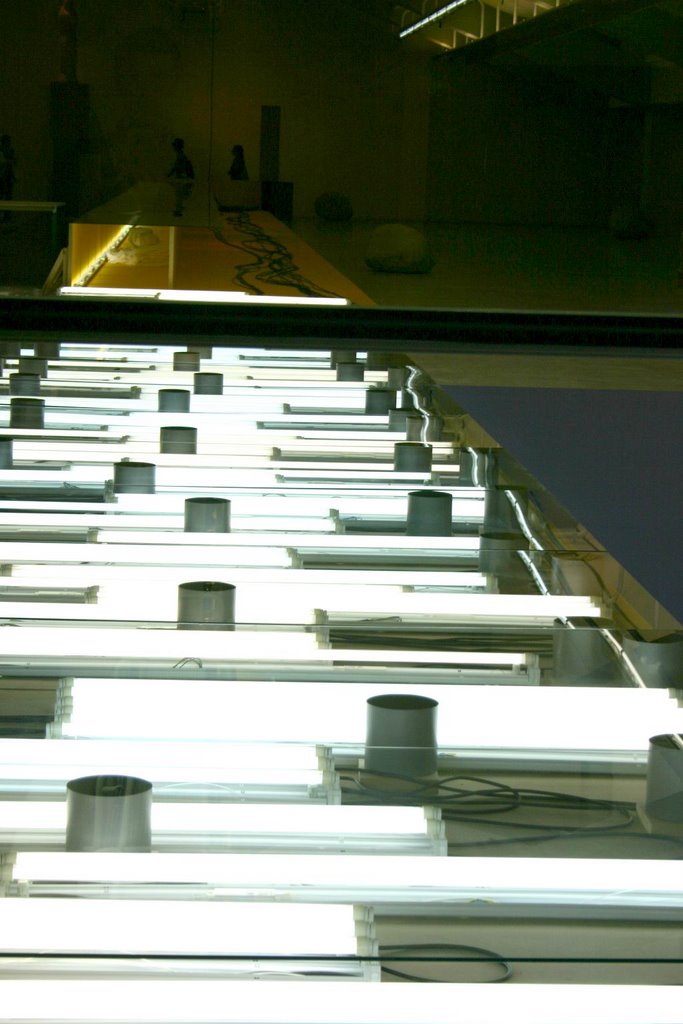
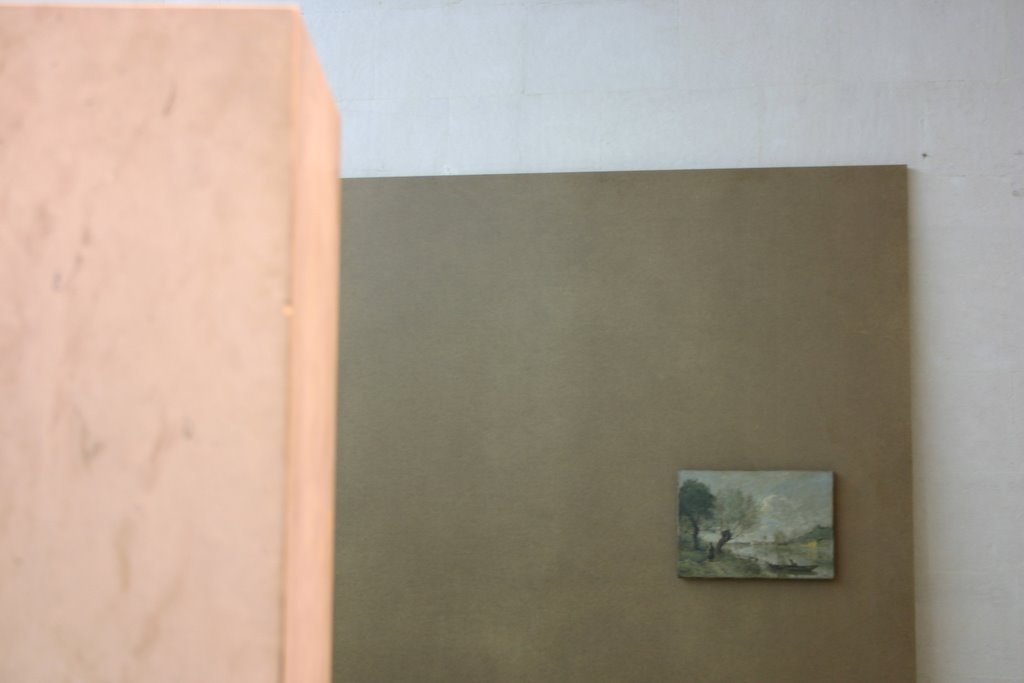
Pedro Cabrita Reis - «Foundation» at the Gulbenkian Foundation


Foundation is, of course, the Gulbenkian Foundation. I have myself had the chance to discover some of the Foundation's warehouses and storage rooms, and it was an impressive experience. The average visitor has no idea that the two buildings, seperated by a medium-size, beautiful park with a pond in the middle, are actually connected underground. And I suppose that's where most, if not all, of the material for Cabrita Reis' work comes from. Neon lights, glass plates, old tables and shelves, cables, more cables, boxes, fragments of stairs, marble bases for sculptures, huge stones... The guts of an institution renowned for its clean, effective approach. The entrails we shouldn't be seeing, impressed as we like to be by the harmonious landscape designed to be seen from the outside, never from the inside. What is the impression now? How does it change our perspective, our view of the basis? The Gulbenkian Foundation can afford this self-irony. It is generous enough, and has good enough taste.

Is this ridiculous? Shouldn't we be analyzing something else? After all, Foundation is, of course, not just this foundation, but the foundation of something, the basis, the beginning, the rule - what Germans call Grund. Knowing Cabrita Reis' work to be often focused on the art world and museum institution as such, this might be the foundation of art, the real foundation of art, apparently chaotic, meaningless, or at least incomprehensible, often unaccessible (we can walk on some parts of the installation, but in an arbitrary way it is decided by the guards that we cannot walk on other parts), complicated, complicated, overwhelming... and yet, somehow harmonious, fitting, as if there was space for us, as if there was space for what we do, for our creation and our appreciation, for free-associating and even squatting on a stone, if we insist (although I haven't tried that, the guards might react).
If all this can be dwelved into, then why do I prefer to describe the Gulbenkian warehouse? Maybe because the one thing that's difficult to comprehend is how direct this link is. We are there, at the Center for Contemporary Art of one of 10 richest foundations in the world. And yet, this is the way it works. This is the foundation. It is a complex game of basic elements. Of course, with a Corot stuck somewhere to a wall.

Saturday, October 28, 2006

On Performance Art, In Lisbon


At last! Some good quality theoretical debate about performance, in Portugal! This is a very unexpected early Christmas gift.
With artists such as Rui Horta and Pedro Tudela, and among the curators, Isabel Carlos and the Portuguese star-curator Delfim Sardo, this is going to be a delicious series of conferences. Considering performance is one of the crucial languages of today's art, this is a must-see.

This series of lectures takes the practice of performance in visual arts as departure point, with a view to covering certain thematic extensions that contribute largely to the definition of the individual nature of each performance.
In addition to an historical approach, the lectures will concentrate on these thematic extensions, thanks to the contributions of a group of speakers from different fields, work areas and artistic domains.
More on the Culturgest site.

Monday, October 23, 2006

WHATCHA GOT UNDER THAT TATTERED COAT?

[This is not my last digression into the difference between illustration and abstract art. It is probably not even my second to last digression. But take heart, because the end is definitely in sight.]
_________________________________________

The inspiration behind abstract art was bold and brilliant. As Holland Cotter wrote about the invention of cubism:
The day of pure optical pleasure was over; art had to be approached with caution and figured out. It wasn't organic, beneficent, transporting. It was a thing of cracks and sutures, odors and stings, like life. It wasn't a balm; it was an eruption. It didn't ease your path; it tripped you up.

The problem is, once artists cast off the shackles of the old standards, there was no consensus on new standards by which to determine quality. By 1918, the Russian painter Malevich, seeking the ultimate essence of painting, produced an all white canvas:


Fifty years later, the American painter Reinhardt improved on Malevich by unveiling an all black painting:


For peasants like you who might question the value of this kind of art, Reinhardt explained: "A fine artist by definition is not a commercial... or applied or useful artist. A fine, free or abstract artist is by definition not a servile or professional or meaningful artist. A fine artist has no use for use, no meaning for meaning, no need for any need." Got it?

Malevich and Reinhardt were conceptually interesting, but modern art had already turned down the path toward its current dead end. Years later, High Performance Magazine, the avant garde journal of post-modern performance art, published the following goofy article on the work of performance artist Teching Hsieh:

Since July when Hsieh announced that for a year he would not do art, look at art, speak about art or think about art , we have been unable to find out any more information.... Friends speculate that the piece grew out of the frustration he experienced trying to organize a one year torch carrying piece that required a minimum of 400 participants. Even after running full page ads in the East Village Eye and other publications, Hsieh was only able to come up with around 200 interested people, whereupon he dropped the idea and announced his "no art" piece. Fallout from the piece has been that he refuses to visit old friends because they have too much art on their walls, and avoids Linda Montano, his friend and collaborator for his last year-long piece in which they were tied together, because Montano is doing a seven year "art/life" piece in which everthing she does is declared art."

Don't believe me? Look it up. Issue no. 32


Obviously, neither Malevich nor Reinhardt nor Teching Hsieh ever read a poem by Stephen Crane (1871-1900):

If I should cast off this tattered coat,
And go free into the mighty sky;
If I should find nothing there
But a vast blue,
Echoless, ignorant--
What then?
Many artists have disrobed in the hope of consummating a relationship with the existential void, only to discover that the existential void ain't interested.

I agree with Clement Greenberg, one of the earliest supporters of abstract art, who wrote:
The nonrepresentational or abstract, if it is to have aesthetic validity, cannot be arbitrary and accidental, but must stem from obedience to some worthy constraint.

Without the constraints of subject matter, objective standards, technical skill, or even the limitations imposed by dealing with a physical object of any kind, the floodgates were opened to charlatans, profiteers and others who dilute the meaning and pedigree of art.


Next: the solution

Wednesday, October 18, 2006


Both pictures are by Margi Geerlinks, at the Aeroplastics gallery in Brussels.
Her works seem very uneven, some are simple "surrealist" plays with meaning, others are quite clever social commentary, others yet - really freaky stuff, way out there. But one thing is sure - she doesn't stop herself from going after what the mind's eye sees. Of course, that might not always be good.
I really liked both the works above. The first one, because making simple yet sustainable statements is extremely difficult. The second, because... what in the world is that? Extremely aggressive, yet organic, what starts off sexy ends with a scandal. And then, why is the scandal a scandal? This reminds me of elephant man, the figure/state and the film. But it's... controversial. In the litteral sense - it goes against the flow. The shock is not in the ugliness. It is in the denial of prettiness. What's wrong with us? What's wrong with us? Why is pretty so pretty? Why is not pretty such a problem? Say it's pretty, believe it's pretty.

There are other works in Margi Geerlinks' portfolio which I simply didn't dare to put here.

MORE ABOUT ABSTRACTION

A few of you have wondered just what the heck I was yodeling about in my last posting on abstract art.

Let's start by acknowledging that abstract art is outside the scope of this blog and outside the scope of my competence. However, I do like some abstract art. If you're willing to take a stroll with an uneducated man into a complex field, we may discover some interesting things together.

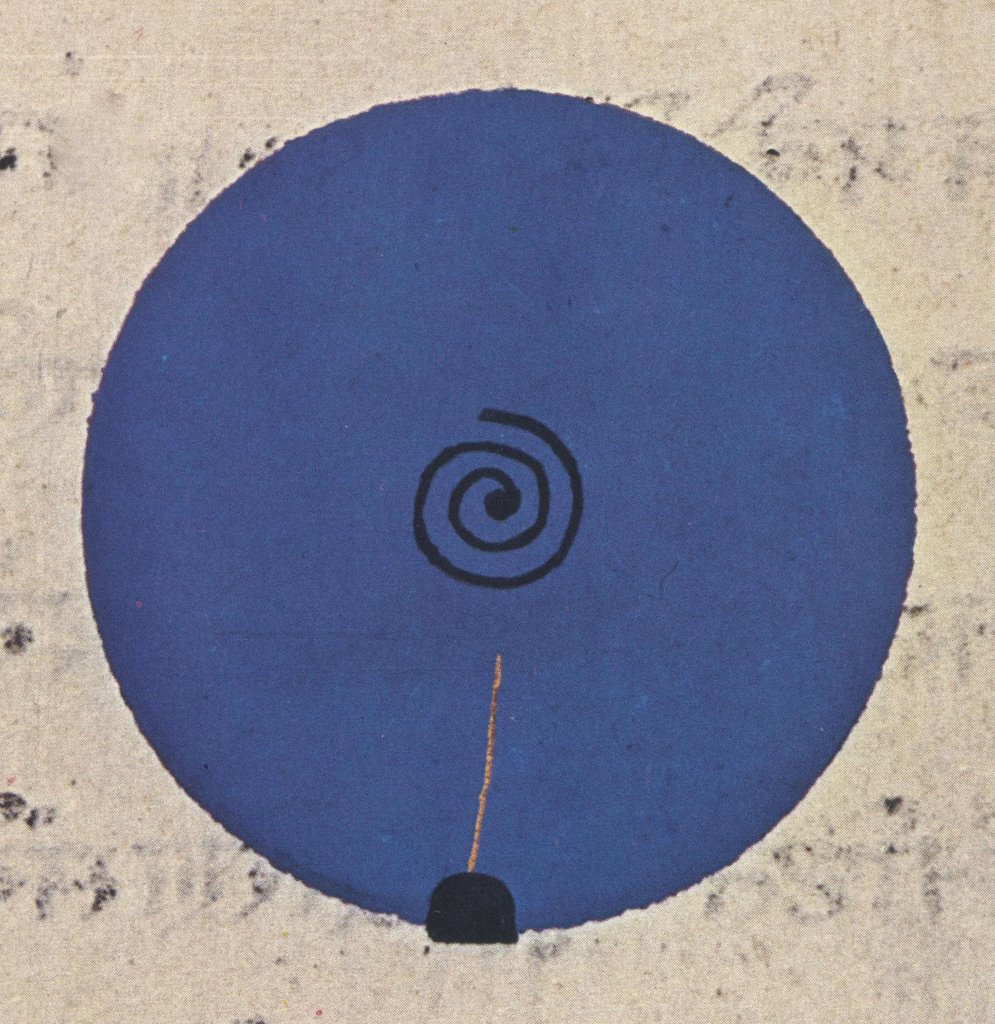
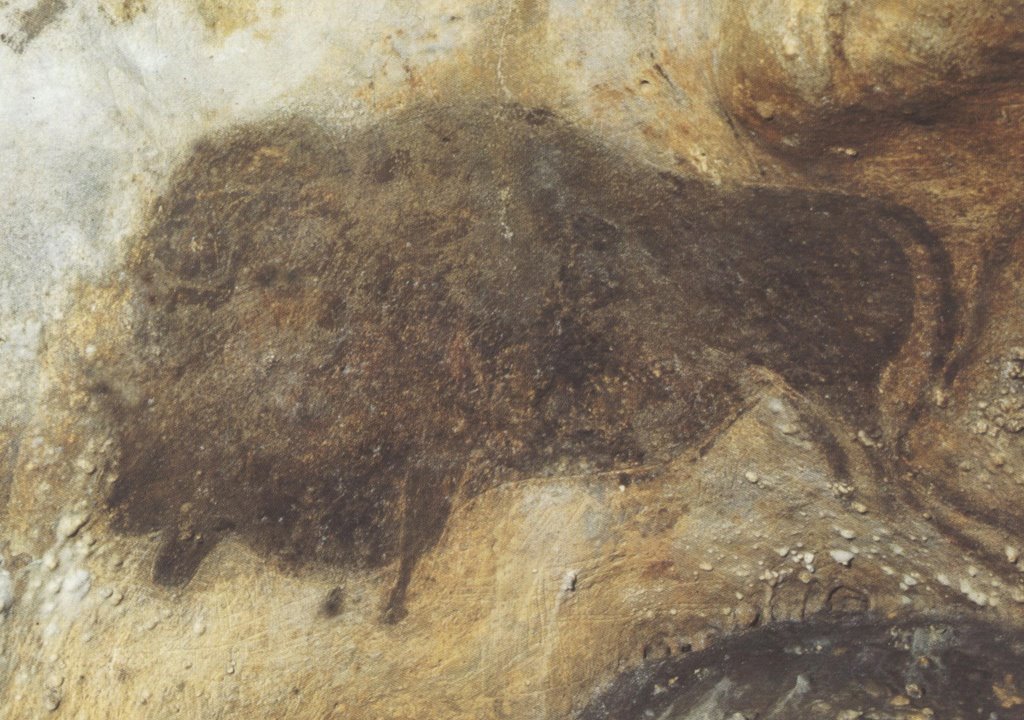
In my view, much of today's fine art scene is self-indulgent nonsense. The Museum of Modern Art in New York contains some great works of art, but the ratio of money to talent there is downright asphyxiating. Dollar for dollar, the art at the Society of Illustrators a few blocks away has more nutritional content. But there is no clear dividing line between art that illustrates a message or idea on the one hand and abstract art on the other. Here are some splendid illustrations that are not very different from the abstract paintings in my last posting:


Illustration of the descent of the divine power through a the symbolic fish-incarnation (from a 17th century Yogic manuscript).


Illustration of the evolution and dissolution of cosmic form from a 19th century Rajasthan book.


Vase painting from Athens in the 5th century BC


Cave painting circa 17,000 years ago.

Clearly, abstract art is no modern invention. It began when art began-- in the upper paleolithic period (from 35,000 to 12,000 years ago). More artistic and technological progress took place in those 25,000 years than in the previous 2 million years combined. That era saw the first explosion of symbolic (abstract) thinking and the accompanying birth of art. The designs and heavily stylized drawings scratched in the walls of ancient caves share a lot in common with today's abstract art. But unlike modern abstract art, which often seems detached and irrelevant, paleolithic art was close to the core of what it meant to be human. It was life-or-death relevant.

I have always liked Anthony Burgess' characterization:
Art is rare and sacred and hard work and there ought to be a wall of fire around it.

Abstract and conceptual art, when it is good, can satisfy that high standard. And since I've blabbered on too long today, I'll offer some thoughts next time on what "good" means to me in abstract art.

Tuesday, October 17, 2006

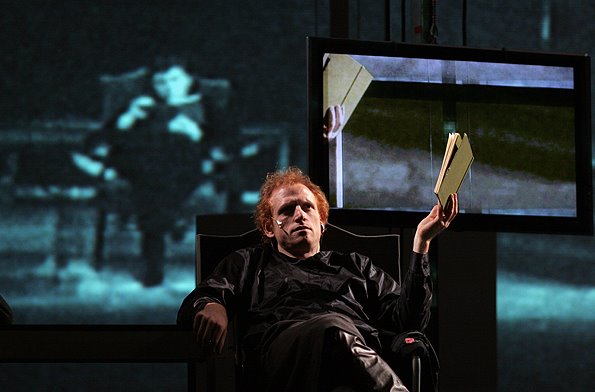
Why I like Elizabeth LeCompte

Wooster Group, Hamlet (2006). Photo Paula Court

Everything I come up with in my head, I put it on stage. But in 90% of the cases it doesn't work, precisely because it's in my head.


I think about what the audience will think. Every single moment. I want to be there, every evening, and observe what people do when they watch the play. If I feel them disengage or feel uncomfortable, it forces me to think about what I really want.

- Elizabeth LeCompte, artistic director of The Wooster Group, in an interview with the French review Mouvement (no.41, oct-dec. 2006). (my translation)

Do the above two quotes appear innocent to you? If they do, you probably don't have much contact with contemporary performance. These two sentences are sure to shock a lot of the avant-garde purists out there. The second sentence is simply a shocker: a seemingly avant-garde artist thinking about the audience? How dare she! She is supposed to be focused on art, on her experience, on the stage, on the essence, or on the periphery, but hers and hers only. The public should be the witness of something beautiful, not a criterium of artistic choice... Oh, how tremendously, absolutely silly. How pretentious, snobbish, irritating. How old and tired and, silly, just silly. And naive.
Notice LeCompte doesn't say the public's opinion decides. She doesn't say she changes everything if the public doesn't like it. But it makes her rethink. In her own words, "it forces" her. She doesn't feel there is really any choice. Is there? Certainly. You can turn your back to the ignorant multitudes and do your own thing your own way for your own self. You can have an inner voice that says this or that. You can be forever faithful to this voice. It's up to you. Or you can have a little modesty. And listen. And respond. Or not. But listen.
The first quote has to do with creativity on stage. LeCompte has no problem saying she has ideas first, then she comes into the rehearsal space and tries them (all!) out. Instead of doing it the traditional, "new" way, devising everything together in one pretty melting pot. Instead of making everything appear out of improvisation, as is expected from a performance group. And if that were not enough, she admits that yes, 90% of her ideas suck on stage. And she doesn't see any problem with that. And it works.
(at least I hope it does. if you want to confirm - go see The Wooster Group's Hamlet at the Festival d'Automne in Paris, Nov.4-10 at the Centre Pompidou.)