Saturday, April 29, 2006

ONE LOVELY DRAWING, part five


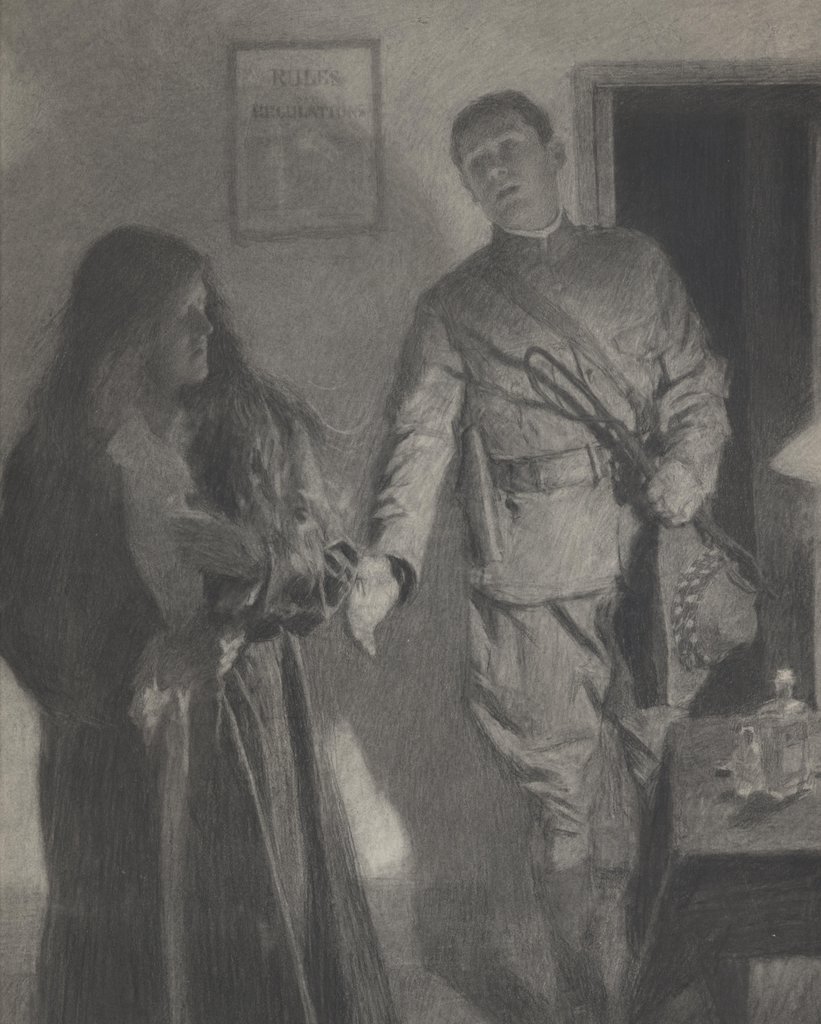
Paging through Victorian era magazines you will find thousands of dull, unimaginative illustrations that long ago ceased to have relevance to anyone. But every once in a while you find an illustration that leaps off the page, grabs you by the lapels and shakes you. The rare artist with "the spark" still stands out.

Most of his peers have been blissfully forgotten, but English illustrator William Hatherell (1855-1928) had "the spark" and deserves to be remembered for it.

This drawing overcomes every disadvantage that the world could throw in its way: working in black and white with charcoal and wash, reproduced in a publication with poor printing quality in a period when the prevailing style was largely fusty and stolid, Hatherell produced a picture of striking strength and vitality measured by the most modern standards.

His composition has all the verve and excitement of an illustration from America in the 1960s. His potent use of values, his vigorous strokes and the careful placement of figures result in a picture more dynamic and lively than much of what is produced today using the latest computer graphic technology. It just goes to show you that even if you are born in the wrong place and time, working with the wrong tools, sheer talent can do a lot to level the playing field.

I don't have access to the original of this drawing by Hatherell, but I am attaching below some details from another one of his drawings so you can see his technique.


Hatherell worked on the staff of a magazine called The Graphic starting in the early 1890s.


In less capable hands, this drawing would lapse into a nondescript puddle of gray. Only Hatherell's mastery of value maintains the integrity of the picture.
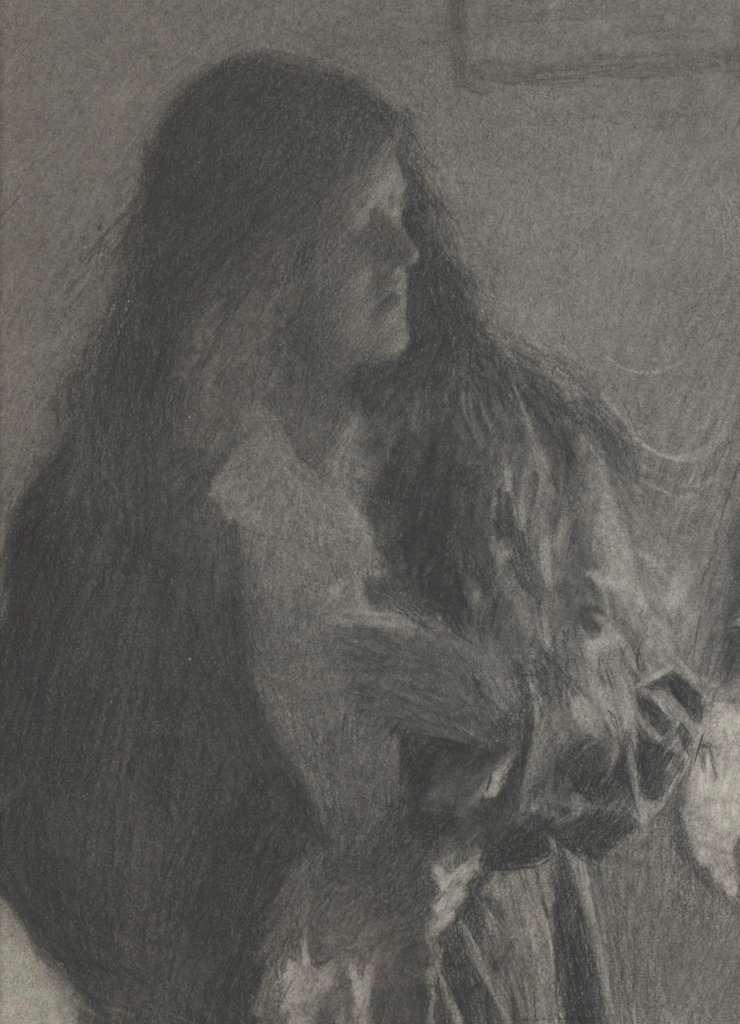


You won't find much of his work around these days, but this was a man who could draw.

Wednesday, April 26, 2006

Work

I have been working hard on a performance by Performaria, an academic group I'm directing. And also, in the free time, seeing films at the Indielisboa festival. I hope to bring more on all of the above soon.

Sunday, April 23, 2006

DAVID LOW: TAKING AN EXTRA DAY TO MAKE IT LOOK EASY


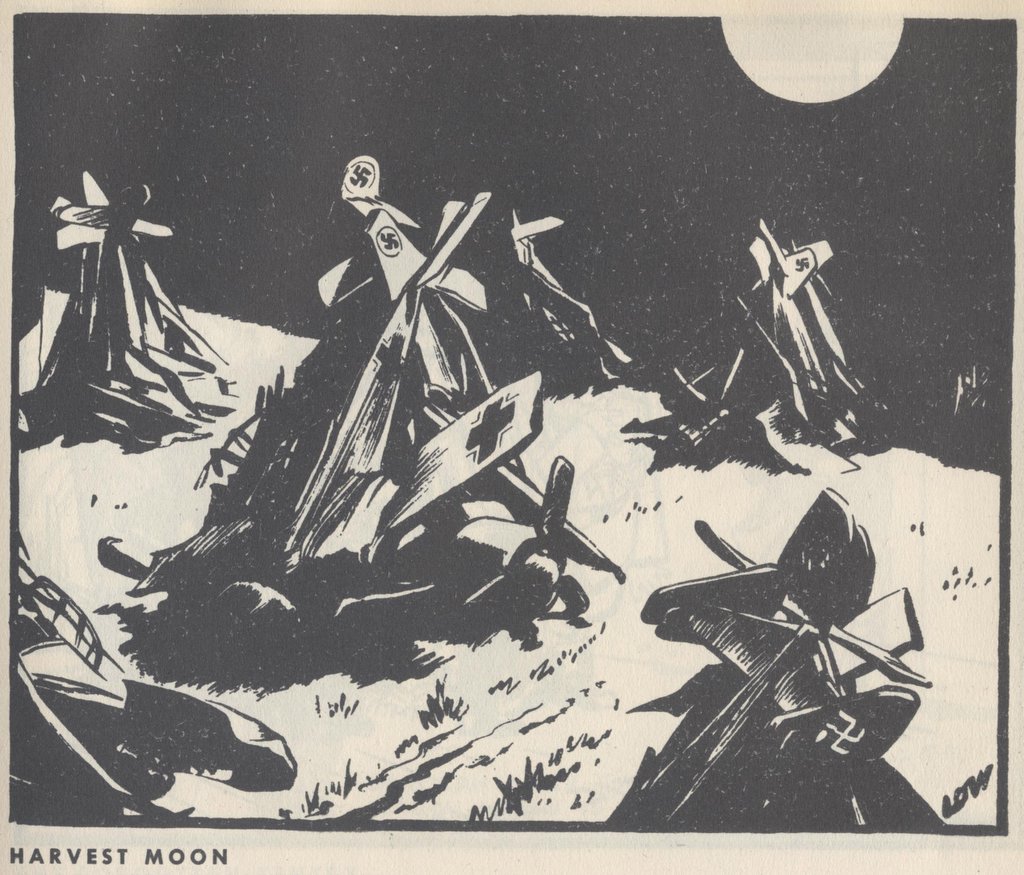
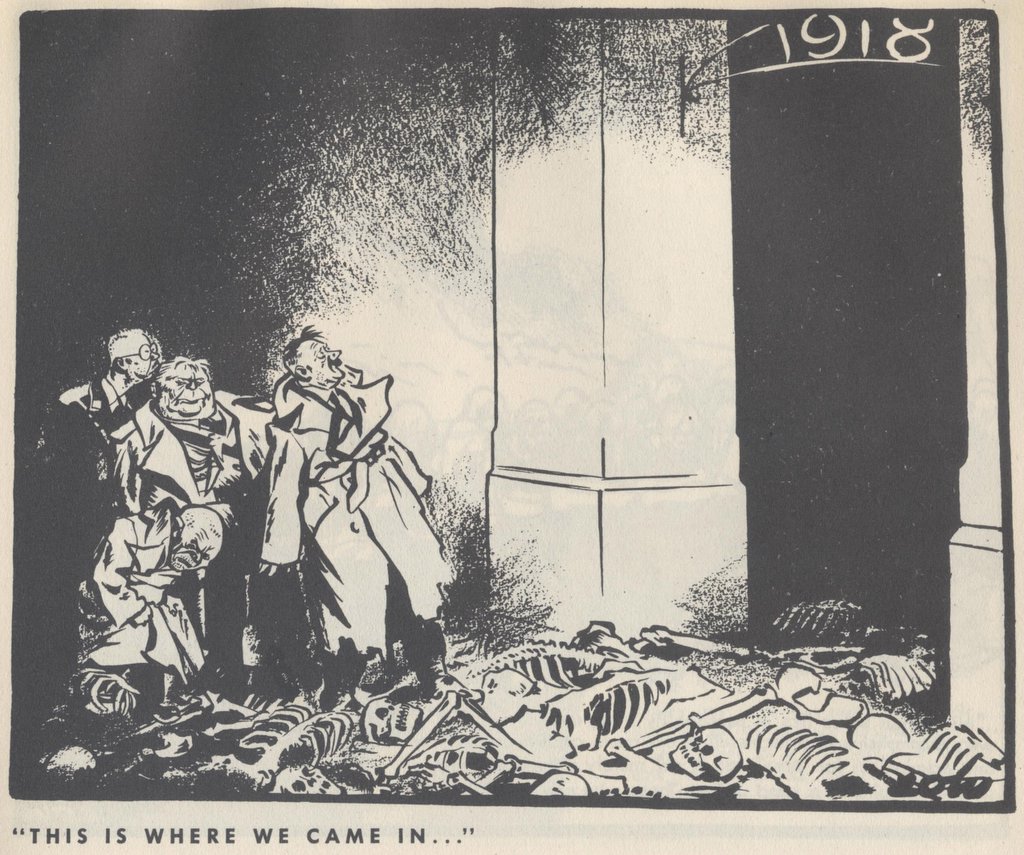
Perhaps the best political cartoonist to emerge from the smoking cauldron of World War II was David Low. The power of his simple, clear drawings took him halfway around the world and protected him from many forms of censorship.


Low was born in a small town in New Zealand in 1891. He learned to draw from studying the pictures in old magazines in the back of a second hand bookshop. The popular style when Low was growing up was fancy, elaborate linework the way Charles Dana Gibson, Charles Keene and Norman Lindsay drew. Low wanted a simpler, cleaner look. His goal was to combine "quality with apparent facility."


Low's direct, powerful style stood out from other editorial art of the day and brought him to the attention of local New Zealand publications, which then brought him offers of employment from Australia, and later from England where the richest and most powerful newspapers bid fiercely for his services. From this forum, Low waged a brilliant graphic assault on the Nazis.

Low's art was not as simple as it looked. He later wrote, "making a cartoon occupied usually about three days: two spent in labour and one in removing the appearance of labour." You can see Low's hard work below the surface in the beautiful body language and facial expreessions of Stalin and Mussolini singing above, or in the salutations of Hitler and Stalin below. Note the tilt of the heads and the angles of the bodies. These are wonderfully choreographed drawings with simple, powerful darks and whites.


By studying the originals up close (see next image) you can see just how blunt and uncluttered Low's brushwork was. He worked large-- a typical cartoon would be 14 x 17.


I love Low's no-frills drawing. Its honesty and toughness stood up to many a powerful enemy. Low was an ardent socialist but he was so good that the staunchly conservative Lord Beaverbrook begged Low to come work for Beaverbrook's newspaper, The Evening Standard. Beaverbrook promised to double Low's salary and give him complete artistic freedom. Beaverbook later grumbled that Low was trying to comandeer the whole paper's editorial policy, but he never dared to censor Low's voice.


Hitler was enraged by Low's scathing drawings, and the Nazi government formally requested that the British government "bring influence to bear" to stop Low. However, nothing was done. After World War II, objections came from the opposite side of the fence: Winston Churchill claimed that a cartoon about the situation in Greece should be blocked "in the interests of western democracy."


Once upon a time, the ability to draw with strong, clear lines and a sharp eye could take you from a small town in New Zealand to the center of the world stage in London where powerful publishers and world leaders would rail against you, to no avail. Low was ultimately protected by the beauty and directness of his work.

Christian Tedeschi


I believe in art that one trips over,
Tumbles blindly
Down several flights of stairs
To end up on their own two feet.
Virtually unscathed, and
Into the arms of their sweetheart.
- says Christian Tedeschi. And it is true of his works: at first glance they seem scary, dangerous, aggressive. But once we look more carefully, we see a light-heartedness that enchants. For once, the heavy matter turns into crystal form. For once, Beuys is misundertood as he should be, without the huffing and puffing of someone too old to be a disciple. And so, the matter dances and plays. It swirls in the air as if it weren't suspended. It moves by itself. But don't be fooled - it does nothing of itself. Even if it takes 10 seconds to reorganize it, the world stands anew. Enthropy? Erosion? A gentle spin of time?

Saturday, April 22, 2006

A Glimpse of Infinity?


Camera Obscura 2005/1-Inf is a worldwide project in which two holes of a twin-holed pinhole camera are being auctioned simultaneously on Ebay every week. This project is dedicated to the polish artist Roman Opalka and his work 1965/1-∞. The highest bidders in each case receive one after the other a pinhole camera loaded with a piece of unexposed sheet of 5x7 Inch b/w film.
There is a sense of global fraternity and timelessness in this project that's appealing. Opałka is a great reference to have - he is an artist I have come to appreciate and there is much to learn from him. One of the things is persistence. Another is discipline. Yet another, choosing the right format. If you get your format right, the work works with you, if not for you.
I'm not convinced that the authors, Przemek Zajfert and Burkhard Walther, figured out the format right. Not that it's bad - it works, and the kaleidoscope of scenes actually starts to develop. The actual photos must be immensely more interesting, with details we can barely figure out or imagine on the net (the quality of the posted pics could be better!). Still, that's just one part of the picture. Another is the question of, well, infinity. Of time. Or rhythm. Or a key of some sort. In this case, there is none. Time is gone, there is no development, and the pictures represent - whatever someone wants them to, plus the usual pinhole surprize. And that's a pity. One could easily imagine a slightly more disciplined version, with a "theme", or some rules that would create a more coherent whole. Otherwise the risk is getting simply too creative.
(Below - images of Opałka's work.)


Wednesday, April 19, 2006

Cattelan's perverted victory


Of course, it's not his fault. He simply made the art. And if someone interpreted it wrong, well, they interpreted it wrong.
As many of you know, in 2004 the Italian sculptor Maurizio Cattelan hung three plastic dolls of children from Milan's oldest tree.
Shortly after being officially "open", the exhibition came to a sudden end: Franco De Benedetto, a Milenese man, decided to cut the children off. He cut two ropes, but swayed and fell when cutting the third one. He was injured and taken to hospital.
Cattelan graciously didn't press charges, but the city of Milan did. And won. De Benedetto will be spending three months in prison for destroying a work of art. Mind you, it took them nearly two years to establish this was indeed a work of art, as that was the prosecution's main argument.

Some say he simply misinterpreted the nature of the work:
Maybe, as the ambulance blared through the Milan streets, di Benedetto was moved to reflect on the violent collision of two types of judgment: civic and aesthetic. He seemed to have mistaken one for the other; or rather, he’d disallowed the second as soon as he set out on his hapless clamber.
I quite disagree. I think the whole work was based on the game between a work of art and a "natural" surrounding. As it is often the case with Cattelan, it was supposed to create uncertainty about the exact role of the work. Only here, it could easily bring uncertainty as to whether the sculptures were real or not.
In places where guns are illegal it is also a crime to pretend one has a gun. Even if you said it was a work of art, you would still be inciting a certain type of behaviour, suggesting a certain reality. I believe this is exactly the case here. This is not to say Cattelan is a criminal, case closed. Not at all. But since he plays in the real world, he should accept the real world's rules. And he does - by neither accusing De Benedetto formally, nor insisting on hanging the children again. But he creates a situation and then washes his hands, as if he wasn't its author. De Benedetto hurt himself and wound up in the hospital. This should be enough. The contact between art and reality is made quite explicit in this fall. The score seems so naturally set. Why go further?

Monday, April 17, 2006

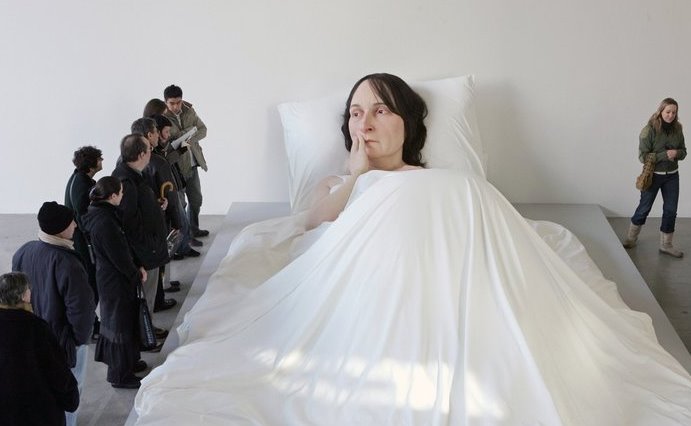
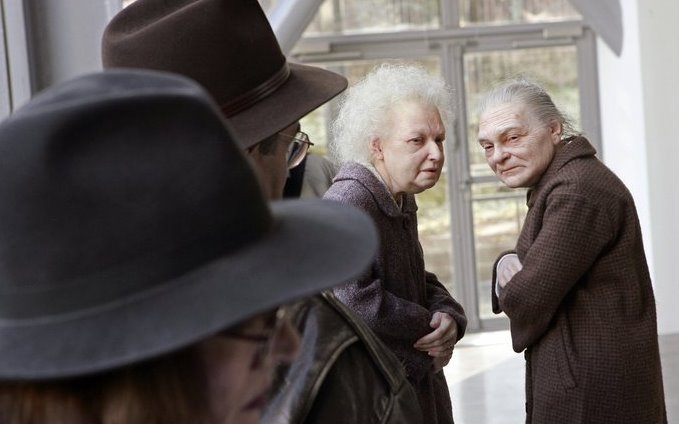
3 pics of people by Ron Mueck


What I like in Ron Mueck's work is not so much the "life-likeness" of the figures (that has been done and re-done). It is their dramatic character, their theatricality. They have their stories, personalities, they are not types of people (like Duane Hanson's characters often were).
The pictures come from the Washington Post and have an added value: they create stories between the sculptures and the onlookers. This performative play, this superimposed dialogue, is a blessing - it takes our attention off the "look how real it looks" aspect and shows another level in the naturalistic technique.