Thursday, February 9, 2006

Angela de la Cruz at the Culturgest: of guts and canvas


I Suppose Angela de la Cruz's art is usually described as the questioning of painting and stretching the limits of canvas. This seems to me not only obvious, but also not-that-fascinating. On the other hand, if we go beyond this label, we might just find a sculptoric experience truly worthy of participation.
Participation, here, implies that the cold world of de la Cruz's objects has a life of its own; it is a process we can investigate and play with, using the wrecks just as the artist does - to transform our perception of... identity? purity? creation?
The idea of recycling being as old as modern art, it is still a challenge. After Duchamp's and Schwitters' collages, after Fontana's holes and Rauschenberg's manipulations, playing with the very material of a painting - i.e., treating it as a sculpture, might seem absurd.
Apparently, though, there is still a lot to be said. Maybe not "rethinking painting", but using it as any other sculpting material, considering the canvas, the frame, the paint, to be primary matter. The magic word here is convention. If we have a convention, we can express things. We can find ourselves in it and, if we feel the need (?), break it, or at least work our way beyond it. And painting, in its technical perspective, is a beautiful convention. It seems to be there just waiting to be distorted, abused or shred to pieces. So what happens when we consider the canvas a partner of a conversation, a performative matter, one that can act out just as a performer would? We get a world full of characters, semi-characters, objects as real as people.

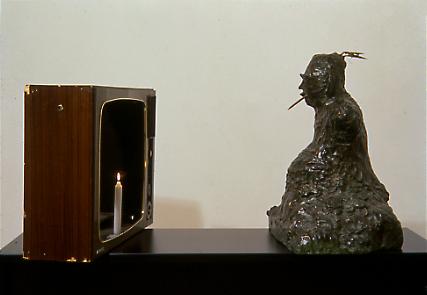
Angela de la Cruz's most recent exhibition at the Culturgest in Lisbon is a voyage through despair. We begin with evidence of violence. Just as there are no perfect people, no painting here actually has a format. The very presence of dimensions next to the work seems ridiculous - they are living proof of the abandonment of dimensions, of the decay of form. Clearly, decay is far from absence. Decay is the period when something happens, the appearance of a form that comes from itself, not from the essential objects. Or maybe, decay, here, is the discovery of an essence previously unrecognized? The paintings hurt, they grow, they break and they hide. There are two, three works per room, and they sometimes resemble cartoon characters, trying to squeeze into a corner or hide on the ground.
But they can't. They are too easily identifiable, colorful, awefuly, frighteningly three-dimensional. In all their havoc, they cannot escape being themselves. Are they the remnants of something gone? That is the first impression, as their designs still recall some original shape. Look carefully, though. The origin is a myth. The danger, says Wittgenstein, is to try to go before the beginning. The beginning is here, in this state of somethingness, in these monstrous, lonely bodies.

As we move on, we discover a difference: someone has been trying to put things back to order. There are stitches, there is glue, there are screws putting it all back together. But try Heraclitus - you can never step in the same river twice. Try all the contemporary Homers - you never go back home. They look miserable, suffering, and strangely familiar, those paintings and objects (delightful chair on a stool, somewhat too surrealist-like yet attractive double piano) that try to remember what they were, or what they should have been.
We move yet further, to a new level. Here, reality is what it is. Things are affirmed. Old sculptures are recycled in new ones, without trying to find their soul. They live new lives, with all their imperfections, they are clustered and folded, they support others, they are the stuff that things are made of. This clean box has some old canvas sticking out behind it. That white sheet of canvas on the ground hides some old guts, some old stories. And it won't get any better than that. Not here, not in any other real world. So we might just as well find it damn attractive.
ps.: If possible, I'll try and take some pictures of the exhibition itself, as the ones above are sacked from the net.

Tuesday, February 7, 2006

Find

There are areas that somehow brush against art. Since a lot of recent works have been based on investigation and discovery of the extraordinary beneath the apparently mundane, this comes surprizingly close to the type of "everyday sociology" that dwelves into the everyday lives of everyday people. I already wrote about Postsecret some time ago. Now here's Found Magazine, a site that publishes pitures of found objects (mainly letters and images). The idea is to get to "anything that gives a glimpse into someone else's life".
Combine this with This Is There, where you can write out your own geographic story (with a little help from our friends at Google Earth), and you get what could be the beginning of a tale...

MARRIED LIFE IN WORDS AND PICTURES


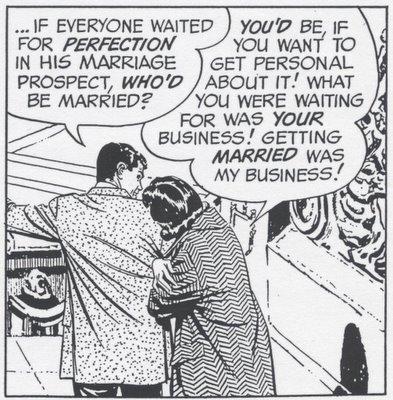
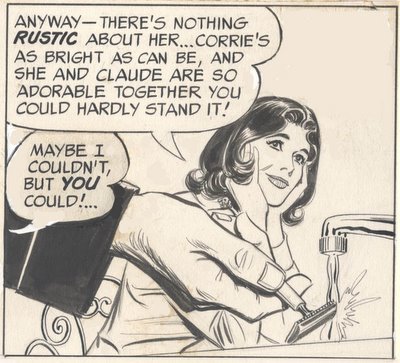
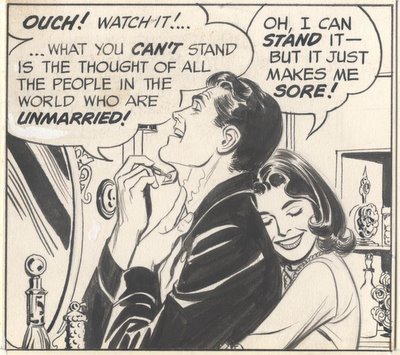
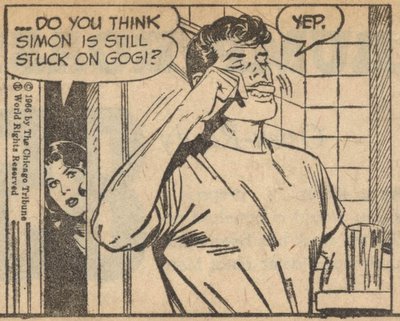
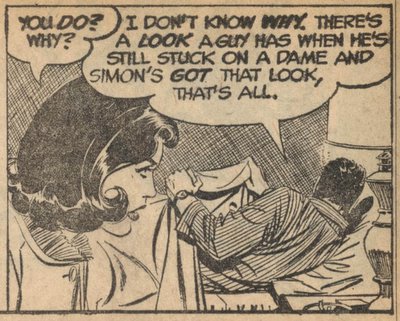
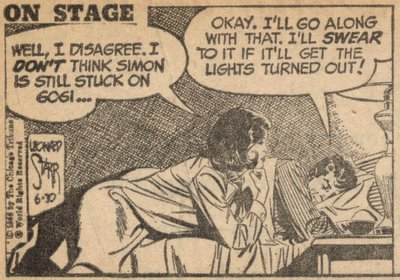
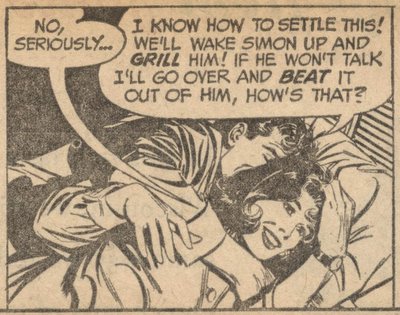
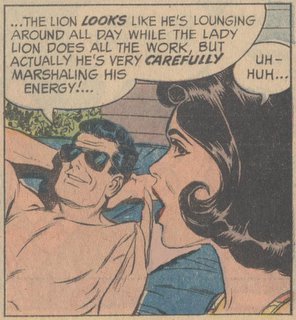
Was there ever a comic strip marriage as great as the marriage of Mary Perkins and Pete Fletcher in Leonard Starr's fabulous strip, On Stage? Mary and Pete had a wonderful relationship, wise and funny and profound. For Valentine's day, I am putting aside my customary rants about quality in art, and offering a bouquet of wonderful moments about day-to-day love from On Stage.


Just like in real life, Pete and Mary chatted in the bathroom getting ready for the day, or in the bedroom decompressing at night. Their dialogue had all the rhythm of an excellent, mature marriage-- something very rare in the medium. Those of you fortunate enough to be in long term relationships this Valentine's day will recognize the following situation where the wife wants to discuss a couple from their dinner party that evening and the husband wants to go to sleep.


Studying these comic strips as a young boy, I learned a lot about drawing-- about anatomy, design, how folds in cloth worked, etc.-- but I also learned inadvertently how relationships were supposed to work. Leonard Starr got me as far as high school, at which time my girlfriend-- now my loving wife-- took over my education. God knows what I would have understood about relationships if I had grown up reading Chris Ware or R. Crumb.

Here we see one of the many diversions from the plot of On Stage, where Pete and Mary break into spontaneous play:


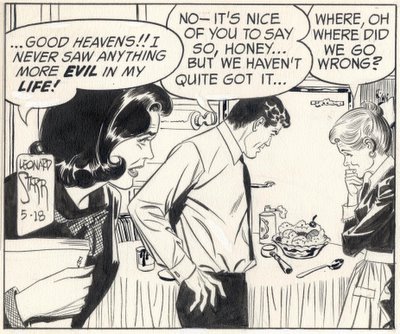
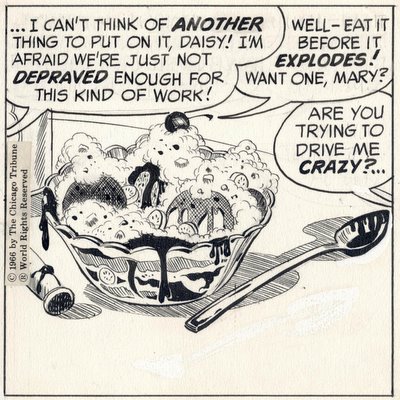
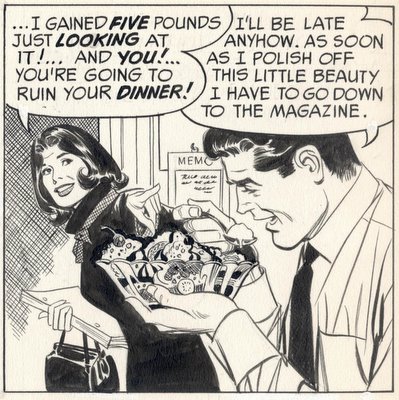
Next is a scene where Starr cleverly uses a domestic episode to show how Pete Fletcher is readjusting to life in the U.S. after a traumatic episode as a war correspondent in Vietnam. Mary stumbles across Pete and their housekeeper trying to make the most spectacular ice cream sundae they possibly can. Pay attention to Starr's unconventional use of the language:


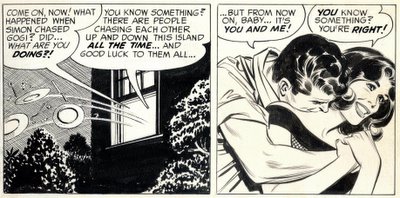
In this final example, Pete throws the dinner dishes out the window, rather than wash them:


I just discovered that the whole wonderful On Stage series is being reprinted by Charles Pelto at Classic Comics Press.(http://www.classiccomicspress.com). I urge you to check it out. And Happy Valentine's Day.


Monday, February 6, 2006

Map yourself, scratch the object


Everything I have ever... is one of those simple ideas that inspire me in my work.
A large (A1) poster with tens and tens of objects drawn out in silver. Scratch one - and it turns orange, just like in a lottery ticket. You decide if it's everything you've ever lost, found, craved, or just not thought about. I have been doing research on the relationship between the apparent neutrality of objects and the total un-neutrality of identity, and this fits like a glove.

Saturday, February 4, 2006

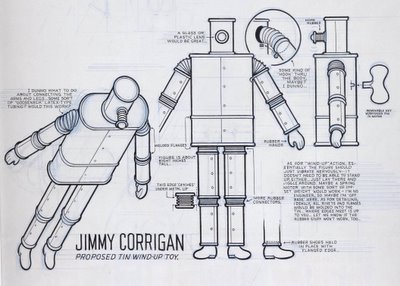
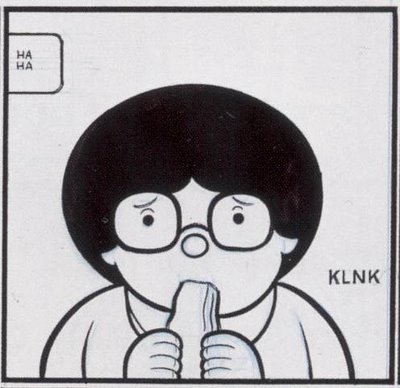
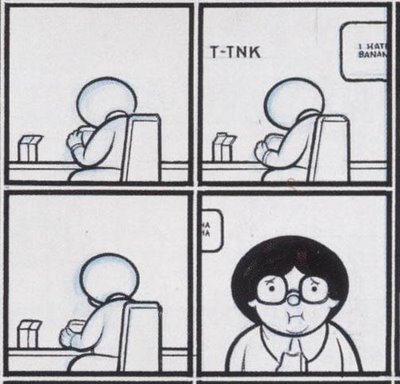
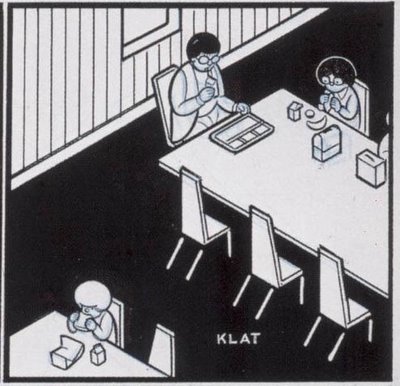
MORE ABOUT CHRIS WARE


Based on the traffic from my last post ("Drawing With Your Brains") I thought it was important to spell out my views on Chris Ware's artwork:

I enjoy Chris Ware's work, but the highbrow critics currently fawning over him drive me absolutely bats. Ware is being offered up as one of the few "Masters of American Comics" (the title of the exhibition at the Los Angeles Museum of Contemporary Art) and is feted at the Whitney Museum and in the pages of the New Yorker. Here is what the LA museum catalog says about him:


"I don't think anyone in any visual medium is making art that is more elevating."

"Ware is capable of creating beauty anywhere and always. Ware's work, in this way, is also quite like Bach's."

"There's glory there. We look at his work and we think of words like sumptuous and exacting and rhapsodic."

"His use of the page is unparalleled."

These people are morons.

50 years ago, there were a thousand key line and paste up artists working for subsistence wages in commercial art studios across the country. They would sit at a drawing board with a T-square and a triangle, creating ads for the backs of comic books and other lofty venues. Virtually all of them could draw as well as Chris Ware. Many could draw better. But because that was an era with different standards, they would have laughed at the suggestion that their drawings were good enough to hang in a museum. Today those key liners have all disappeared, swept aside by technology and the invisible hand of Adam Smith. But Chris Ware is hailed for the same mechanical drawing skills.


I don’t begrudge any artist who wins the lottery in today's society, whether it’s Chris Ware or Thomas Kinkade. Ware has some admirable qualities. He is a decent writer and a diligent artist who has created his own interesting world. He is disciplined enough to create a substantial body of work, and the cumulative effect is certainly showy. But if you deconstruct his accomplishment, you will find it easier to evaluate.


Ware’s work combines three disciplines: artist, graphic designer and writer. Taking them in order, it is hard to argue that his "art"-- the actual drawings inside the panels-- is anything better than competent. He draws in a monotone, with little of the variety, the sensitivity or wisdom of line, the composition, design, or the other qualities that have traditionally been the hallmark of great drawing. Ware would have made an excellent key liner, and that was an honorable profession, but anybody knowledgeable about sequential art or illustration should have no trouble identifying 500 superior artists. As an aside, Ware also hasn’t discovered that an artist who wants to depict a repetitive and bleak life cannot simply resort to repetitive and bleak drawings. Important lesson.


Weak drawing skills are not fatal to a creative enterprise, so let's move on and talk about Ware's second (and more important) discipline, graphic design. Ware is more a designer than an artist. His work is interesting and sometimes complex. However, the critic who wrote, “he really has no stylistic predecessors….No one can do what he does, so no one is even trying” has obviously never heard of constructivism or the modernist school of commercial design 80 years ago. He must have been oblivious to the thousands of labels and posters and advertisements by underpaid and anonymous commercial artists who invented Ware’s style.


That leaves the third component, his words. This is extremely important because the whole thrust of the "concept art" school is that so long as you are diagramming great thoughts or peerless words, it doesn't matter that you are not an accomplished artist measured by traditional standards. My own view is that Ware’s words cannot compare with an excellent essay, play, or poem, but you can form your own opinion. I suspect that mainstream critics pay attention to Ware's words only because they are enhanced (or redeemed) by the clever diagrams. And that leads us to the bottom line:

Establishment art critics, always late to the party, think they are cool when they descend to the subculture of graphic novels and sequential art. Yet, they can never manage to untangle the words from the pictures to make an honest appraisal of either one. Literary critics tend to say "this person writes pretty well for an artist" while art critics tend to say "this person draws pretty well for a writer." But as a general rule one can't produce great works of art by combining merely good words with merely good pictures. Chris Ware's art is, IMO, merely good. But that's not so bad.


I hope this fleshes out my previous post on "Drawing With Your Brains." I have nothing against Chris Ware. I'm not sure he deserved to be singled out as a representative sample of the concept art phenomenon. However, I suppose that anyone who is repeatedly embraced as a genius has to be ready for alternative opinions.

As with my previous post, I welcome any examples, jpgs, quotations or explanations of Ware's work that help me understand where I missed the boat.

Friday, February 3, 2006

Nam June Paik


Nam June Paik died yesterday.
Few artists deserve the name of avant-garde artists as much as Paik did. His faith in the intimate link between technology and art was one of the fundaments of today's new art. Starting off in the early 60's, he was first more connected to live performance. In the 80's he moved towards large multi-monitor installations. He gave technology a soul. He made art seem fun and intelligent at the same time. At times it seemed as if the fun, experimental and/or esoteric aspects took over, leaving less room for intellectual aspects, but even those works had a power that mesmerized, hypnotized and inspired a whole generation of artists. Actually, come and think of it, he inspired more than a generation, since his works are still seen today as innovative and fresh.

Here is an excerpt from New Media in Art:
The (...) 'art'-oriented video histories will usually point to the day in 1965 when Korean-born Fluxus artist and musician Nam June Paik bought one of the first Sony Portapak video sets in New York, and tuyrned his camera on the Papal entourage that day making its way down Fifth Avenue. That, in this view, was the day video art was born. Paik apparently took the footage of the Pope, shot from a cab, and that night showed the results at an artists' hangout, the Cafe a GoGo.


more about Nam June Paik:

Sound Gardens

Hello again!

Here is something that has been around for some time as an idea, with a few small-scale realized projects - but now it seems to be growing quite fast.
The Tactical Sound Garden is an environment (i.e. potentially a physical space of any city) where users of devices such as iPods and other portable sound systems with wireless communication can discover the sounds implanted by others.
In practice this means one walks into a space and hears different sounds. As one moves along, the sounds (songs, noises, voices?) change, new ones appear.

The Tactical Sound Garden [TSG] Toolkit is a vehicle for exploring this via the design of an infrastructure: an open source software platform for cultivating public "sound gardens" within contemporary cities. It draws on the culture and ethic of urban community gardening to posit a participatory environment where new spatial practices for social interaction within technologically mediated environments can be explored and evaluated. Addressing the impact of mobile audio devices like the iPod, the project examines gradations of privacy and publicity within contemporary public space.


Several interesting points about this sort of developments:
- A walkman stops being a synonym of alienation. It can become a shared experience.
- The trust in human goodness is boundless. As the average age of an iPod user (or, what's more significant, a "qualified user") drops, these Gardens, invisible to a common passer - by who might have pu social pressure to keep it tidy, can very well become depositories of some of the most uninspiring sound garbage. ("NOT INCLUDED in the Toolkit are regulations for governing the use (or abuse) of the garden. This is left to the gardeners to sort out. TSGs are intended as self-organizing systems.")
- The audio part of space suddenly becomes a brave new world. It will create specific, isolated communities that are a gem to any advertiser: they have money and time to spend. I wouldn't be surprized, then, if this artistic endeavor soon took on a new twist and became a sort of a commercial radio, where one can discover the wonderful soundscapes for the modest price of having them brought to you by "Chico-Chico, the chocolate that makes it all sound great".
- What exactly is a sound garden? Or rather, what can it be? Are there some possibilities we haven't thought of yet? Rhythms? Conversations? Plays? Games? Dances in public spaces? Lessons? What else?