
Wednesday, June 8, 2011
VW Art Car Tent For Sale - Get your Camping on!!!

IS IT OKAY TO LIKE PULP ART?

Last week the Society of Illustrators opened a wonderful exhibition of pulp magazine covers from the 1930s and 40s. The show includes nearly 90 paintings of scantily clad damsels in distress, hooded fiends with elaborate torture devices, and futuristic space heroes. This is probably the most emotionally uncomplicated art you will ever find: big, juicy paintings with the open heart (and emotional maturity) of a 14 year old boy.
Some of the paintings, such as this gem by the great Baron Leydenfrost, are executed with astonishing skill:

But most of these pictures are painted with a technique as vulgar as their content. There was no room for subtle colors and elaborate compositions on a magazine rack crowded with competing pulp magazines.

The girls on these covers always seemed to be in peril, and ripe for rescue by the proper hero.

Young male readers were tantalized by the prospect of what lay beyond those slightly parted dressing gowns or those strategically torn shirts. They pored over these illustrations for clues to what awaited them someday. It's a mark of their innocence that their best plan for winning such favors was by rescuing a girl from space monsters.
If you're looking for a holiday from moral complexity, pulp art may be just the oasis for you. In fact, the owner of this marvelous collection, Robert Lesser, calls it “escape” art. But its simple mindedness is the source of both its joyful strength and its gnawing weakness.
Which brings me to my question of the week: Is it okay to like pulp art?
Let's put aside that this stuff is politicallly incorrect. My question is focused solely on artistic merit. Is this stuff anything more than “chewing gum for the eyes”? What are we to make of art that is not particularly well painted and does not challenge us mentally or emotionally, that raises no questions and doesn't expand our vision, but is undeniably likable for nostalgic reasons?
Let's put aside that this stuff is politicallly incorrect. My question is focused solely on artistic merit. Is this stuff anything more than “chewing gum for the eyes”? What are we to make of art that is not particularly well painted and does not challenge us mentally or emotionally, that raises no questions and doesn't expand our vision, but is undeniably likable for nostalgic reasons?
Beryl Markham cautioned us about the temptation to look over our shoulder at simpler, bygone days:
Never turn back and never believe that an hour you remember is a better hour.... Passed years seem safe ones, vanquished ones, while the future lives in a cloud, formidable from a distance. The cloud clears as you enter it. I have learned this, but like everyone I learned it late.
This is a worthy sentiment, but I nevertheless think pulp art is a valid art form. The moral obviousness of these pictures gives them an ethical virility that you won't find in more sophisticated art. They are akin to religious paintings from the age of faith, which left no ambiguity about who was the bad guy, who was the hero, and which blonde needed to be rescued.
The fact that such ethical clarity is an illusion doesn’t mean it isn't art.
The fact that such ethical clarity is an illusion doesn’t mean it isn't art.

Sunday, June 5, 2011
Sharing the Sensible (In a Rich Man's World)
The thing is: I'm very excited about performance moving forward. And I love how it invades all sorts of territories. I do it, watch it, write about it. It's my cup of tea. That is precisely why I don't want to leave it with an "interesting experiment" tag. Experiments have their consequences, results, and it seems crucial not to stop at the freshman enthusiasm for everything about everything that is anything new. What I like most about the experiment I will criticize below is that it dared to go far, to talk to people, to uncover hidden layers in unexpected places. And yet, it troubled me.

In Gerardo Naumann's "Factory" performance during the Warsaw edition of the inspiring Ciudades Paralelas festival - we are taken on a guided tour of a functioning factory (in Warsaw it was an enormous steel factory). However, this is not your average tour. Here, we get the possibility of witnessing private stories of workers, to hear who they are, both within the company context and outside of it. The tour is at times poetic, at times simply human and direct. Every presentation mixes the description of a person's job with more personal matters. Our first guide is the factory's technical director, then we go all the way down the (wage) hierarchy to the gardiner, who also has his stories, telling us of his love for 60's music (Deep Purple et al.) and even making us listen to some of it. A truly human experience in an unexpected context.
So what is it that makes me uncomfortable about it?
It is an unwilling, yet uncritical, PR event for a huge, powerful and hardly uncontroversial business.
The project seems to follow closely the teachings of French philosopher Jacques Rancière - for several years now he has been advocating a change of paradigm in the way we look at others. Teaching something, or learning, should mean, above all, realizing how the way other people see the world is just as valid as ours - it is a structure that is already a "complete" structure, they are also "teachers" and we - students. To put it in other words - everyone is competent. It might just be a question of acquiring the possibility to further develop this competence.
Rancière gives this example: workers in a factory can also be seen as art aficcionados, as they have their (art, or aesthetic) specialities, their passions, their expertise. Tapping into this is, according to Rancière, a crucial step towards going beyond the simplistic emancipatory claim of passing on the "correct" sensibility.
The "Factory" project follows Rancière's ideas closely. And yet, all the while achieving an arguably closer relation with the subjects/performers, and while making us feel a bond with many of them, while amazing us with the aesthetic aspects of a factory, its dynamics and dramaturgy, it fails in an important aspect: it underestimates the power of the structure it works in.
"Just" showing the lives of the workers is never just showing their lives. It necessarily functions within the context. And this context, here, wins. The tour/performance becomes a scarily effective way of implementing propaganda. We are still given stories about how magnificent it is to work here, how everyone is happy, safe, friendly, how everyone who worked in the factory during communist times participated in strikes, and how the only mentioned case of someone getting fired... got immediately offered another job. And because a skillful theater director does it, we hardly feel manipulated. On the contrary, the "genuine" feeling prevails. We leave happy that things are as they are. We love the stories, the people, the parallel city, the way it works, the world it works in. It is difficult to imagine a better publicity.
But wait - could all this be true? Maybe it is a good company? Maybe it is happy and safe and the best of possible industry worlds? Well, it's enough to make a quick news check - there was a fire in the factory just a few months ago, and just recently the company just layed off many of their executive personnel (apparently they were transferred to another company for "effectivity reasons" and were subsequently fired). I dig a little deeper. ArcelorMittal - that is the name of the company, is owned by the 6th richest person in the world (with a personal wealth of $38.1 billion - link). The company made 10 billion dollars profit last year alone. On the other hand, since the company started taking over Polish factories, it diminished its staff by some 3000 workers in Poland (ca. 25%).
This type of criticism could be contested. Should this matter? Should the work of art take this into account?
Can it? How?
Can we play with the system, within the system? Can we work our works so as not to become victims of the same propaganda we would usually receive - or worse, not just victims, but advocates?
Or can we ignore this and consider that not all works of art need to be political, or not necessarily in that sense, that it can also be about the people who work there, that they too have the right to be important subjects, and not just the megarich owner of their company?
But if we just move in and focus on them, while remaining on the factory ground, if we call it a Parallel City (Ciudades Paralelas means Parallel Cities), aren't we playing the status quo game? Aren't we the perfect PR people, giving the company - and the world which it co-creates - our seal of approval, a "positivist" acceptance? (A disturbing trait of the performance is that the workers/performers come and go - without too much of an introduction, and with no goodbye whatsoever, so while we are kept entertained, they have nearly no chance of receiving our recognition, or of establishing a human contact beyond the script. The beginning and the end is clear - it is the Ciudade Parallela, the company, not the people). Doesn't the critical art, so cherished by Rancière, become uncritical because of the very same (human) aproach he proposes?
So how are we to make - and look at - art in all those parallel cities that are more and more often taken over, or at least manipulated by, the powers that be, be they economic, or more directly political?
The fight here is indeed a fight over the sharing of the sensible - how do we value what we see? How can we reevaluate it? What sort of sharing is this? What do we want out of this situation? How can we, as artists, but also as viewers (viewers are artists, but artists are viewers too, to many people's surprize), find a common ground without becoming the agent of some powerful megastructure? Should we worry about it?
Banning the word "Facebook" on TV might seem like a silly idea, but I know some theater companies who do not use any brands in their shows. And for them, it's not about having the power to change the world. It's about enjoying the possibility.
----
Curiously enough, I was told that when Naumann made an analogous performance in Buenos Aires, the factory was a small and badly run one, and some commentators thought he was too rough on it, making it look very bad. One possible answer is: this format simply gives you the possibility to take a peek inside - and whatever you find there has been there already. But another possible explanation is: it may not be enough to implement a "personal guided tour" formula if we want to move beyond the small industry into the big guys' terrain, where they know how to charm us, seduce us, and make it appear like it's all immaculate. Then, it seems, it would need to be a whole new ball game.
---
I have a vague recollection of reading about a performance by the great Brazilian visual artist and performer Hélio Oiticica (I couldn't find the reference now). I believe it took place in the 70's. Oiticica walked around the public space, pointing at different objects. The spectators which followed him understood (were told?) that through the gesture, the objects acquired the status of works of art.
Oiticica's enchantment with the world seems clear. This is what the world is like, he seems to be saying. Look at this piece of art! I couldn't have done this better. The only thing I can do is to point it to you.
What would happen if Oiticica did the same thing in the factory? Would the objects he pointed at stop becoming art? Certainly not. The factory would gain the status of an aesthetic object - it would become the same marvel as any of the trees, benches, stones, clouds. Look at this piece of art! I couldn't have done this better.
Could we not?

In Gerardo Naumann's "Factory" performance during the Warsaw edition of the inspiring Ciudades Paralelas festival - we are taken on a guided tour of a functioning factory (in Warsaw it was an enormous steel factory). However, this is not your average tour. Here, we get the possibility of witnessing private stories of workers, to hear who they are, both within the company context and outside of it. The tour is at times poetic, at times simply human and direct. Every presentation mixes the description of a person's job with more personal matters. Our first guide is the factory's technical director, then we go all the way down the (wage) hierarchy to the gardiner, who also has his stories, telling us of his love for 60's music (Deep Purple et al.) and even making us listen to some of it. A truly human experience in an unexpected context.
So what is it that makes me uncomfortable about it?
It is an unwilling, yet uncritical, PR event for a huge, powerful and hardly uncontroversial business.
The project seems to follow closely the teachings of French philosopher Jacques Rancière - for several years now he has been advocating a change of paradigm in the way we look at others. Teaching something, or learning, should mean, above all, realizing how the way other people see the world is just as valid as ours - it is a structure that is already a "complete" structure, they are also "teachers" and we - students. To put it in other words - everyone is competent. It might just be a question of acquiring the possibility to further develop this competence.
Rancière gives this example: workers in a factory can also be seen as art aficcionados, as they have their (art, or aesthetic) specialities, their passions, their expertise. Tapping into this is, according to Rancière, a crucial step towards going beyond the simplistic emancipatory claim of passing on the "correct" sensibility.
The "Factory" project follows Rancière's ideas closely. And yet, all the while achieving an arguably closer relation with the subjects/performers, and while making us feel a bond with many of them, while amazing us with the aesthetic aspects of a factory, its dynamics and dramaturgy, it fails in an important aspect: it underestimates the power of the structure it works in.
"Just" showing the lives of the workers is never just showing their lives. It necessarily functions within the context. And this context, here, wins. The tour/performance becomes a scarily effective way of implementing propaganda. We are still given stories about how magnificent it is to work here, how everyone is happy, safe, friendly, how everyone who worked in the factory during communist times participated in strikes, and how the only mentioned case of someone getting fired... got immediately offered another job. And because a skillful theater director does it, we hardly feel manipulated. On the contrary, the "genuine" feeling prevails. We leave happy that things are as they are. We love the stories, the people, the parallel city, the way it works, the world it works in. It is difficult to imagine a better publicity.
But wait - could all this be true? Maybe it is a good company? Maybe it is happy and safe and the best of possible industry worlds? Well, it's enough to make a quick news check - there was a fire in the factory just a few months ago, and just recently the company just layed off many of their executive personnel (apparently they were transferred to another company for "effectivity reasons" and were subsequently fired). I dig a little deeper. ArcelorMittal - that is the name of the company, is owned by the 6th richest person in the world (with a personal wealth of $38.1 billion - link). The company made 10 billion dollars profit last year alone. On the other hand, since the company started taking over Polish factories, it diminished its staff by some 3000 workers in Poland (ca. 25%).
This type of criticism could be contested. Should this matter? Should the work of art take this into account?
Can it? How?
Can we play with the system, within the system? Can we work our works so as not to become victims of the same propaganda we would usually receive - or worse, not just victims, but advocates?
Or can we ignore this and consider that not all works of art need to be political, or not necessarily in that sense, that it can also be about the people who work there, that they too have the right to be important subjects, and not just the megarich owner of their company?
But if we just move in and focus on them, while remaining on the factory ground, if we call it a Parallel City (Ciudades Paralelas means Parallel Cities), aren't we playing the status quo game? Aren't we the perfect PR people, giving the company - and the world which it co-creates - our seal of approval, a "positivist" acceptance? (A disturbing trait of the performance is that the workers/performers come and go - without too much of an introduction, and with no goodbye whatsoever, so while we are kept entertained, they have nearly no chance of receiving our recognition, or of establishing a human contact beyond the script. The beginning and the end is clear - it is the Ciudade Parallela, the company, not the people). Doesn't the critical art, so cherished by Rancière, become uncritical because of the very same (human) aproach he proposes?
So how are we to make - and look at - art in all those parallel cities that are more and more often taken over, or at least manipulated by, the powers that be, be they economic, or more directly political?
The fight here is indeed a fight over the sharing of the sensible - how do we value what we see? How can we reevaluate it? What sort of sharing is this? What do we want out of this situation? How can we, as artists, but also as viewers (viewers are artists, but artists are viewers too, to many people's surprize), find a common ground without becoming the agent of some powerful megastructure? Should we worry about it?
Banning the word "Facebook" on TV might seem like a silly idea, but I know some theater companies who do not use any brands in their shows. And for them, it's not about having the power to change the world. It's about enjoying the possibility.
----
Curiously enough, I was told that when Naumann made an analogous performance in Buenos Aires, the factory was a small and badly run one, and some commentators thought he was too rough on it, making it look very bad. One possible answer is: this format simply gives you the possibility to take a peek inside - and whatever you find there has been there already. But another possible explanation is: it may not be enough to implement a "personal guided tour" formula if we want to move beyond the small industry into the big guys' terrain, where they know how to charm us, seduce us, and make it appear like it's all immaculate. Then, it seems, it would need to be a whole new ball game.
---
I have a vague recollection of reading about a performance by the great Brazilian visual artist and performer Hélio Oiticica (I couldn't find the reference now). I believe it took place in the 70's. Oiticica walked around the public space, pointing at different objects. The spectators which followed him understood (were told?) that through the gesture, the objects acquired the status of works of art.
Oiticica's enchantment with the world seems clear. This is what the world is like, he seems to be saying. Look at this piece of art! I couldn't have done this better. The only thing I can do is to point it to you.
What would happen if Oiticica did the same thing in the factory? Would the objects he pointed at stop becoming art? Certainly not. The factory would gain the status of an aesthetic object - it would become the same marvel as any of the trees, benches, stones, clouds. Look at this piece of art! I couldn't have done this better.
Could we not?
Saturday, June 4, 2011
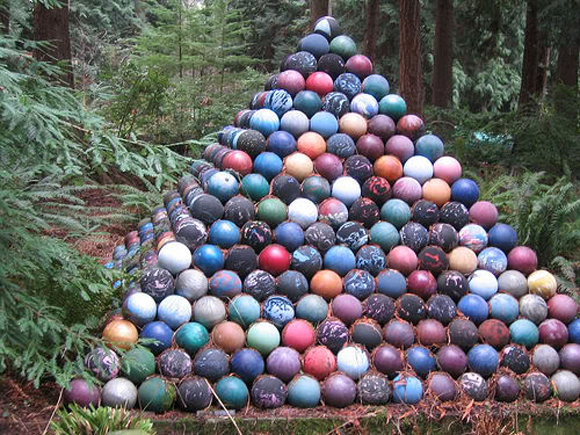
Bowling Pin Art Car Strikes Out - 1785 Bowling Ball Pyramid

What is the sound of 1785 bowling balls striking a pin car? If it happens in the woods and no one is around does it make a sound?

Thursday, June 2, 2011
Art for Poetry
 My portrait drawing of Oscar Levant
was used for a poem written
by poet Jeff Roberts -
Sadly, Our Geniuses Linger
(for Oscar Levant)
Website: Jeff Robert's Poetry
Wednesday, June 1, 2011
Help Charlie The Unicorn Art Car Go to Burning Man

Ken and friends are building an art car for Burning Man 2011 based on the legendary video “Charlie The Unicorn”. They have setup a Kickstarter project to help raise funds for its completion and a Charlie Camp group on Facebook.
Subscribe to:
Posts (Atom)