Sunday, January 30, 2011

Art Car Phone Looses Dial Tone - Destroyed by Roof Collapse

Art Car Phone Looses Dial Tone - Destroyed by Roof Collapse
The Phone Car Crushed by Collapsed Roof - Front Side

The world famous Phone Car created by Howard Davis was brutally damaged recently when the roof of the Avon Industrial Park collapsed due to snow build up. The Phone car will not be making any long distance calls anytime soon, but with a little TLC and some bondo it can be up running soon. Our best wished for a speedy recovery goes out to you.

Art Car Phone Looses Dial Tone - Destroyed by Roof Collapse
The Phone Car Crushed by Collapsed Roof - Front

Art Car Phone Looses Dial Tone - Destroyed by Roof Collapse
The Phone Car Crushed by Collapsed Roof - Rear Side

Art Car Phone Looses Dial Tone - Destroyed by Roof Collapse
The Phone Car Crushed by Collapsed Roof - Side
Photos by Howard Davis

Mercer Island - 70th Ave SE

Oil on canvas, 24" x 30"

Saturday, January 29, 2011

ARTISTS AT WAR, part two


The illustrator Harry Everett Townsend (1879-1941) was born on a small farm in Illinois. As a young boy he showed early talent, painting signs for local farmers on the delivery route for his father's peddling wagon.

But farm life was too confining for Townsend. As a teenager, he struck out on his bicycle for the big city and when he got to Chicago, enrolled in the Art Institute where he studied under
Lorado Taft. But Townsend remained restless and after two years he moved on to Wilmington Delaware where he trained under the famed Howard Pyle. From there he made his way to Europe to study briefly at the Academie Moderne in Paris.

When he turned 25, Townsend married and seemed to settle down as an illustrator working in New York for magazines such as
Scribner's, Harper's and Century.


Century Magazine

But Townsend remained hungry to see the larger world, and when World War I flared up, Townsend volunteered to cover it. He wrote, "I had gotten drunk, as it were, with the future pictorial possibilities in what I saw, and what my imagination saw, in the warfare that was so soon to come."

Townsend was one of eight artists chosen by the U.S. government to be official "war artists" accompanying the Armed Expeditionary Forces. (Other AEF artists included two other Pyle students,
Harvey Dunn and W.J. Aylward). Townsend's war diary records his excitement about his upcoming adventure:
I left New York in a blinding snow, into the submarine zone with its constant alarms, and through it. My trip through London... with an air raid thrown in.... and the nervous excitement of finding myself suddenly in the war zone, for, while one realized at all times the dangers on the sea, one really felt he had arrived when he found himself in the midst of the bursting of enemy bombs and the sight of enemy planes....
It didn't take long for Townsend to witness the effect of those "bursting enemy bombs:"
Everywhere among the blownup trenches and in the shellholes are pieces of what were once men. Here and there, a whole or a piece of bone; here and there a shoe with a foot still in it.
In addition, the incessant rain and cold spoiled many of his artistic ambitions. Yet, Townsend drew a series of powerful pictures such as this poster:


"Refugees fleeing a storm tossed area, with all the sorrow and misery and pathos that went with it...."

As brutal as his experience was, Townsend believed there was no substitute for an artist witnessing his subject personally:
In hindsight, Tragic and moving... But I knew that not to have seen it during the conflict was not to have seen it as it really was, even for pictorial reference... And I am thankful I was there and I am conscious of the opportunity I had to see and gather material and, better than the actual material, the impressions, spiritual and material, that alone can furnish the inspiration for a convincing pictorial record of what the great struggle was like.
Townsend's wartime experience seemed to have an impact on his style, replacing his light and airy drawings for Century Magazine with a bolder, darker outlook.


Don Pittenger has suggested that great war art is usually not created in the heat of battle, but only afterward, a safe distance from the fighting. Townsend seems to have agreed with this. He wrote after the war, "now I felt ready to achieve something of my ambitions, counting as of little, even ephemeral value , the things we had been able to do during the time we were so nervously, yet energetically, storing up for the future.... Perhaps the greatest pictures of the war can only come with time."

Unfortunately, the U.S. government had neither the time nor the budget nor the interest to commission "the greatest pictures of the war." One suspects that the government was never interested in "great pictures" so much as it was interested in effective pictures for the war effort. In either event, the eight war artists were quickly disbanded and sent home to their civilian lives.

In truth, Townsend seemed to have little interest in pursuing those "greatest pictures" either. He wanted nothing more than to return to normalcy. He settled down in the small town of Norwalk, Connecticut where he bought an old barn to use as a studio, painting domestic scenes and teaching art. And he never moved again.

Friday, January 28, 2011

Yellow, Red, and Purples on Orange

Oil on canvas, 24" x 24"

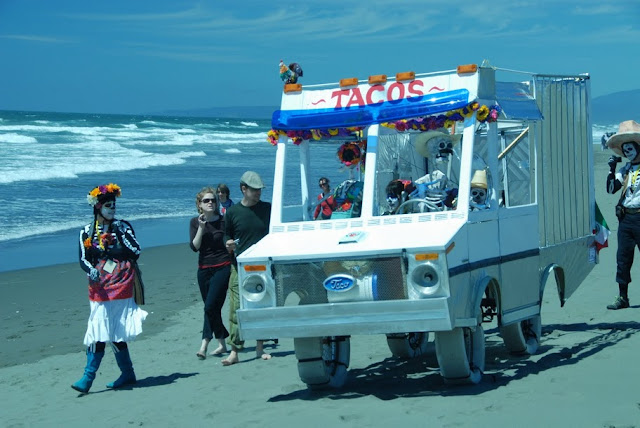
Dias de los Muertos Taco Truck - Kinetic Sculpture Race

Dias de los Muertos Taco Truck - Kinetic Sculpture Race
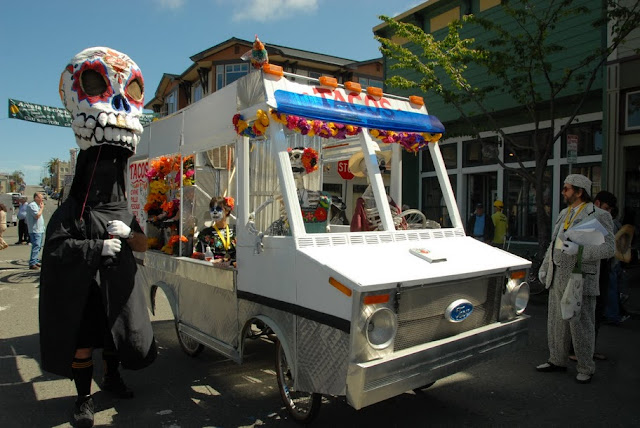
Dias de los Muertos Taco Truck - In Parade

The Kinetic Grand Championship is a 3-day, 42-mile bicycle race over land, sand, mud and water. Many refer to the Kinetic Grand Championship as the “Triathlon of the Art World.”

The race began 40 years ago in 1969, when world-renowned sculpture artist Hobart Brown challenged Ferndale artist Jack Mays to a race down Ferndale’s Mainstreet. In their kinetic contraptions they started a 40-year Humboldt tradition that has spread to Oregon, Washington, Arizona, Colorado, Baltimore, Maryland and all the way to Perth, Australia. But it all began here among the majestic redwood groves of Humboldt County.

Day 1 of the Kinetic Grand Championship starts on the Plaza in Arcata, California at the noon whistle every Memorial Day weekend. The racers take off to the Manila dunes, where they race through miles of sand to the great and inevitable “Deadman’s Drop.” Then on to Eureka’s downtown gazebo.

Dias de los Muertos Taco Truck - Kinetic Sculpture Race
Dias de los Muertos Taco Truck - More Parade

Day 2 starts in Eureka at the waterfront on the Humboldt Bay, where brave Kinetic Pilots race their crafts through the water (most float). Then back on land where kinetic sculptures go up Hookton Hill, a 1 mile-7% incline and decline. Day 2 ends with a private campout for racers and volunteers only.
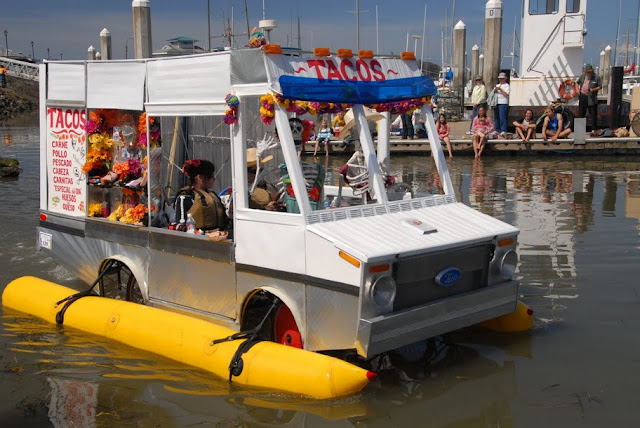
Dias de los Muertos Taco Truck - Kinetic Sculpture Race
Dias de los Muertos Taco Truck - Floating

Day 3 starts from the mouth of the Eel River, through Morgan slough and onto dry land. Racers cross the finish line on Ferndale’s historic Mainstreet, where racers park and head up to the Final Awards Dinner at Ferndale’s Fireman’s Hall.

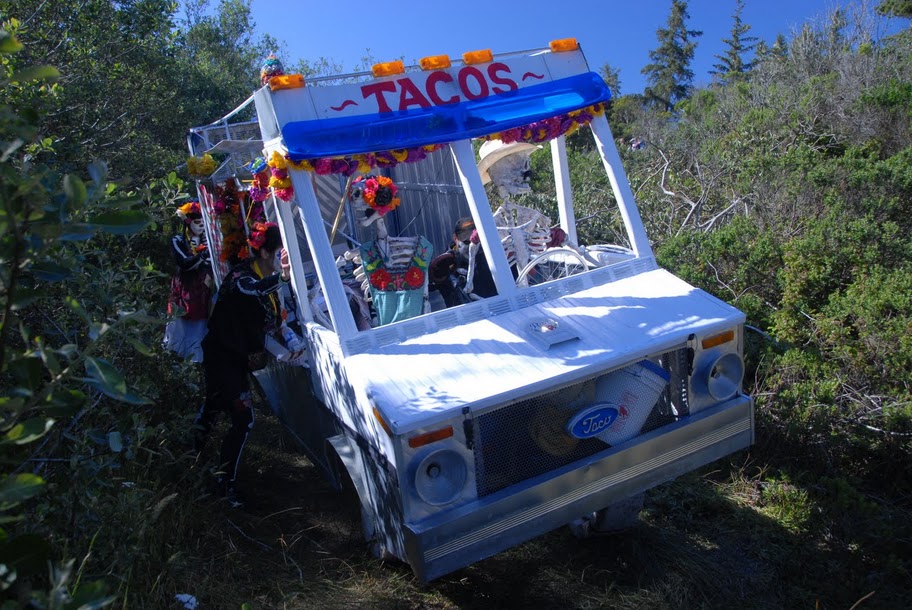
Dias de los Muertos Taco Truck - Kinetic Sculpture Race
Dias de los Muertos Taco Truck - Land Race

Dias de los Muertos Taco Truck - Kinetic Sculpture Race
Dias de los Muertos Taco Truck - Beach Race

What is a Kinetic Sculpture?


Kinetic Sculptures are all-terrain human-powered art sculptures that are engineered to race over road, water, mud and sand. Kinetic sculptures are amazing works of art; many are animated with moving parts like blinking eyes, opening mouths, heads that move side to side and up and down.

Kinetic Sculptures are usually made from what some people consider “junk”. But one man’s junk is another racer’s raw material. Each Kinetic Sculpture is a work of art and each racing team has its own theme.

The teams consist of pilots, pit crew and pee-ons. Kinetic Pilots pedal the sculpture and steer, the pit crew assists the pilots in transforming the vehicle for the various elements and fixing mechanical issues, and pee-ons, well, they do whatever is needed for the team to get glory. The teams give out “bribes” to their adoring spectators, judges and Rutabaga Royalty.

Spectators are encouraged to follow the race on their bikes (obeying all traffic laws that apply please). Seeing these marvels of art and engineering turns many people on to bike culture and reminds people how much fun riding your bike can be!

Who Wins?

Good question! Well when Hobart Brown started the Kinetic Sculpture Race 40 years ago, he lost the race he created! Now one of the most coveted awards is the “Mediocre Award.”

Other awards include “The Golden Dinosaur,” which is the first sculpture to break down after the start line, “The Golden Flipper,” for the best flip of a sculpture in sand and water, and “Poor Pitiful Me.” Racers can also “Ace” the race, which means they race the entire course for 42 miles without pushing or ''getting caught'' cheating. Each award is handmade by a local artist!

via Kinetic Sculpture Race
Photos by Tina Kerrigan Photography

The Sauna - Riding the Alps in Style

The Sauna was built from a Volvo 240 and taken on CzechWrecks 2009, a 1500 mile 4 day journey starting from Calais, France through Swiss and Italian Alps all the way to Prague, Czech Republic.

What we have here is about 1/3rd of a ton of wood paneling being applied to the Volvo.

If you are wondering whether this wood had any impact on performance, I am assured it did. What performance they had to start with, remember that Volvo 240 are agricultural at best, that performance was soon zeroed.

Chris and Tom and their team built this car to raise money for charity and an opportunity to travel in their bath towels riding the sauna over some of the highest passes in Europe.