Mondo Spider The Mondo Spider is a 1600 lb, 8 legged walking machine originally built by a Vancouver-based team of artists and engineers in 2006. Initially gas-powered, the spider has been converted to run entirely on battery power, making it the world's first 100% electric, zero-emissions walking vehicle. This vehicle will be at this weeks Maker Fair
Do you drive fast and are Tired of Red Light Camera Tickets? Austrian artist Ferdinand Johannes has solved this problem by creating the most advanced Porsche ever, called the Ferdinand GT3 R-S, The World's Slowest Porsche. He has come up with a way to avoid all traffic tickets by installing a revolutionary new power source under the hood called the "bike" with a whopping 1MP (Man Power). Not only will it NOT go 0-60mph in 10 seconds, but probably wont go past 10mph, EVER.
Let me tell you what it DOESN'T have:
No turbocharge,
No 450hp
No 3.8 flat-six engine
No Disk Brakes
No Manual gearbox
No Sound System
No Club sport package
No Leather Seats
No Airbags
No Roll cage
No 6-point drivers racing harness
Rest assured that there will be no more traffic tickets once you unleash the pure bike power of the Ferdinand Porsche GT3 R-S.
11 min, 16 mm film, B/W, no sound Camera: Bill Rowley Edit: Elaine Summers Dir: Elaine Summers Prod: Hans Breder, Iowa University
There are two things about this short fragment I love. The first is the choreography of joy. The slow-motion allows us to better appreciate the flow of the common movement, the combining of the bodies, the contrast between them and everything that happens around them. But there is something else. The dance becomes obvious at the end, when the movement continues beyond what we expected. Yet there is one earlier moment, one step of the girl coming from "our" side, which makes that clear. At a very precise point, she deviates from the way she has been running, her body bends like a bow and then moves sideways. That is when the simple vectors of meeting become something else - something more complex, less obvious. The bodies, now, create a space for our meeting to go beyond the embrace.
They invented perfect beauty, those ancient Greeks.
Of course people made beautiful things before the Greeks, but it was the Greeks who dreamed there could be a perfect version of beauty out there waiting to be attained.
Aristotle made the first serious attempt at defining "perfection" but even before him Pythagoras and other pre-Socratics speculated about an ideal beauty. They pursued it with the language of mathematics, asserting that objects look better when proportioned in accordance with the "golden ratio." They believed objects would appear more "complete" and "perfect" if they were symmetrical, with clean shapes in harmony with classical archetypes.
They hoped these principles would lead them to perfect beauty. Unfortunately, they didn't get very far before the goat-god yanked them back.
The Greeks were so confident that their culture was superior, imagine their surprise when the good citizens of Athens began to lose interest in high culture and stray back to the more earthy, passionate cults of their barbaric neighbors. Historian Arthur Koestler claims that Athenian gods lost their attraction as they became more formal and detached from base human emotions:
At an unknown date, but probably not much before the sixth century, the cult of Dionysus‑Bacchus, the 'raging' goat‑god of fertility and wine, spread from barbaric Thracia into Greece. The initial success of Bacchism was probably due to that general sense of frustration ... [that] the Olympian Pantheon had come to resemble an assembly of wax‑works, whose formalized worship could [not] satisfy truly religious needs.... A spiritual void tends to create emotional outbreaks; the Bacchae of Euripides, frenzied worshippers of the horned god....
The Greeks discovered that their lofty aspirations were chained to their earthy goat-god origins. High culture could only take them so close to "perfection" before they ran out of chain.
Greek poets bemoaned the effect of Bacchism on their womenfolk: "Theban women leaving/Their spinning and their weaving/Stung with the maddening trance/Of Dionysus!"
Today we still admire the Greeks' smooth, classical ideals of beauty but we too remain tethered to the goat-god part of our nature. Art becomes less satisfying as it becomes too orderly, smooth and formal. We cannot polish and refine our way to perfection; beyond a certain point, perfection begins to weaken art rather than strengthen it.
Koestler described how the savvy Greeks absorbed and blunted the threat of wild Bacchism:
The outbreak seems to have been sporadic and short‑lived. The Greeks, being Greeks, soon realized that these excesses led neither to mystic union with God, nor back to nature, but merely to mass-hysteria.... The authorities seemed to have acted with eminent reasonableness: they promoted Bacchus‑Dionysus to the official Pantheon with a rank equal to Apollo's. His frenzy was tamed, his wine watered down, his worship regulated, and used as a harmless safety‑valve.
The Greeks' wise technique for co-opting wildness is still employed by artists today. A carefully controlled picture often includes an uncontrolled splatter or eruption or rough line-- not enough to lose control of the picture, but enough to show that wildness still has a seat in the artist's pantheon:
Jeffrey Jones carefully captured facial features, but then indulged in a frenzy for her hair
Note how the great Ronald Searle gains power with from uncontrolled spatters and ink drops.
This sensitive portrait by Jack Unruh would not be nearly as potent if he had not gone back and roughed it up with that dense black and spattering.
Even the erudite Steinberg bows to the virility of non-cognitivism: he draws the icons of civilization with a light and lacy line, but adds strength with a rough, black scrape of a brush.
Pictures still pay tribute to the goat-god, and are rewarded with his strength and vitality
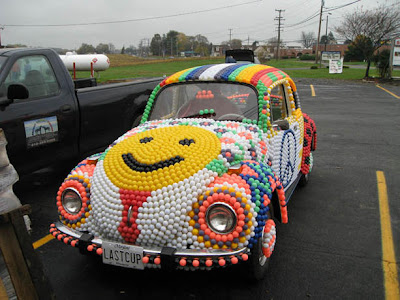
Katherine Smith, of Jarrettsville, glued 8,000 colored ping pong balls on an old 1971 Volkswagen Beetle named "The Last Cup". Her art car features different scenes each section of smiley face hood peace sign on a even the hub caps and bumpers are covered with ping pong balls.
Bikes with shoes instead of tires is definitely a better alternative to using bike tires which need air and tend to go flat. All you need is a bunch of shoes and you are good to go, oh and a helmet would be good as well.
Todd Kundla rides his Shoe Bikevia Walking Bike by Max Knightvia
Travis Pastrana Shoe Motorbike
Be sure to check it this cool video with Travis Pastrana doing flips with his shoe motorcycle.


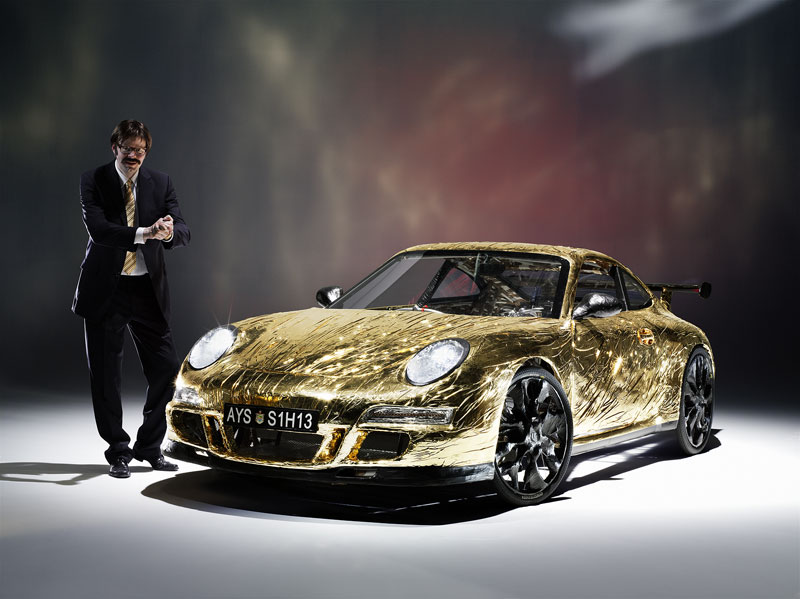
 Austrian artist