How could I have missed
this!
Santiago Sierra is back. And, as usual, he's creating a stir. If it seemed to you he's been controversial enough, paying people to be tattooed or to carry stone squares around or to stay walled in during an exhibition, well, this time he seems to have outdone himself.
His project, called
245 Cubic Meters, was
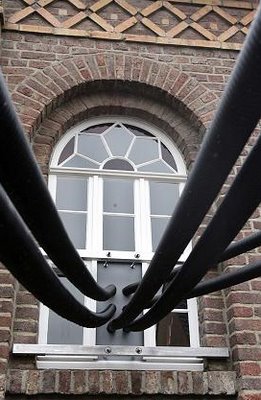
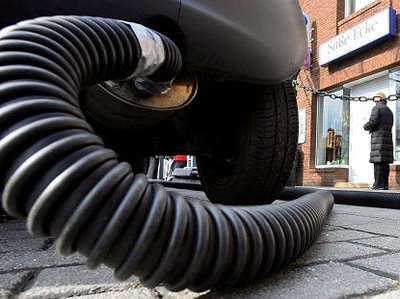
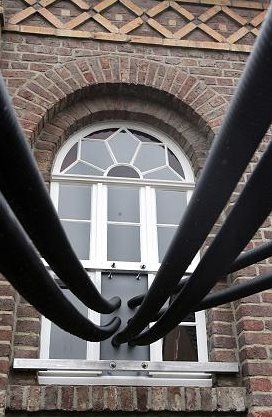
to give people a sense of the Holocaust by pumping lethal car exhaust fumes into a former synagogue and letting visitors enter one by one with a breathing apparatus.
I suppose everything worked out as planned: huge
outrage,
criticism, and a public debate about
art, it's possible role in society and the way it can, should or does influence us.
The exhibition was
suspended.
Here is my take on it.
1. I don't agree with the critics that claim Sierra's work is exactly what it claims to fight, i.e., "the trivialization of the Holocaust", as the artist put it. I don't think something becomes trivial just because you make a direct reference to it. Obviously, this isn't Disneyland, and nobody going in there must have made it light-heartedly. This is a very serious, heavy matter. When death is near, it is really too simple to discard it as "trivial".
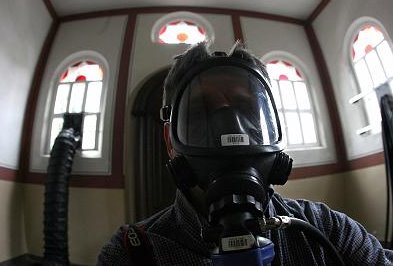
2. Taking place in Germany, the work can be seen as a cleansing ritual, more than a gesture of rememberance. Many Germans I know never dared to ask their fathers or granfathers what they did during the war (Hans in his note to my last post notes the ever-present figure of the goo-bad uncle).
3. Part of the cleansing is certainly the aethetic aspect of the work. Walking in an abandoned synagogue is a strong emotion. Walking with a firefighter-guide makes it even more surreal.
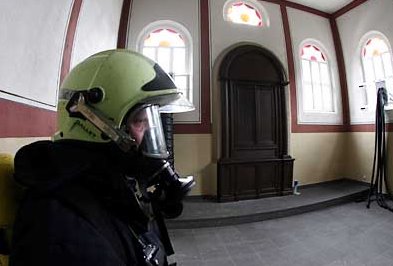
4. The firefighter is a very strong element. It was misinterpreted by several commentators as the proof of how ridiculous an attempt at restaging the drama can be. Well, I think it rather shows that this is not a restaging. This
is a work of art, and is to be treated as such. It tells a story which goes beyond itself. It is not about reliving the moment. It is, maybe, about the possibility of reliving the moment. About the power of a place. Authenticity - yes. But authenticity of a place, of a history, of an event. Authenticity of a gas and of our reaction to it. Of the precautions we take. Today.
5. If Sierra was actually after the creepy feeling that all this was real, if he wanted to "remember", he could have simply made a trip to Auschwitz. It is a horrible, horrible place. I'm still not sure if I think it is a good thing for it to exist. Its struggle for memory gets scarily close to a fascination with death, the same one that makes us look at an accident or listen to a horrible story. Yes, it makes us remember. But I'm not sure if the cost is not, well, some sort of a pornography, if you may, an indecent exposure of something that really should have been put to rest. Nonetheless, it exists - it's there to see for anyone unsure if his memory is correct, unsure if he has enough disgust for what people can do to other people. I don't think we need Santiago Sierra to remind us of that.
6. The difference is that Sierra made his piece in a gallery space. In a synagogue. In Germany. I am really tired of having Poland associated with the Holocaust (I think I mentioned it some while ago). This work puts the finger to the wound. Right where it (still!) hurts.
7.
How pretentious to seek to evoke their horror and fear of death in such a cheap way! In a cynical game which yields no insight whatsoever. - says a newspaper.
For some time, Santiago Sierra has been asking one question: "What if it were you?". His works are exercices in empathy. They are often cruel exercices. In this sense, yes, they get cynical.
This reminds me of the famous
Stanley Milgram, a scientist often accused of cynicism, who discovered that most people can be unhumanly cruel by creating simple conditions (orders coming from an authority) that made them do what they thought to be acts of great cruelty. Milgram was accused of turning people into murderers, as if they were toys to play with. Sierra is accused of "hurting the dignity of the victims", as if they were toys to play with. I really don't see how the dignity of the victims is being hurt. And, contrary to some of his other works, here Sierra doesn't actually
use anyone, he doesn't turn people into something just (?) for art's sake.
8. What he does play with is memory. And guilt. The synagogue is the sign, it is what made the difference when the selection was made during the war, it was what
identified the victims and what
differenciated them from the others (the killers, but also the by-standers). Here, the visitor becomes at once the victim, the perpetrator and the by-stander, the observer. Being the art spectator he is, he cannot help but have a distance. At the same time, he goes inside, he participates. He repeats history. As a victim, or as a re-creator?
9. To me, this last question is going too far. And not because it crosses some line of decency. Because from what I can imagine and see on the pictures (once again:
what can I imagine and see on the picture? how far can imagination get me?), the conceptuality of the work is simply unbearable. Bluntly speaking: it seems boring. It is the second work by Sierra that I find interesting as a concept, but have difficulty finding strong as an actual
work (The first one was
300 tons). I really don't feel like walking through an empty synagogue with a fireman just so Santiago Sierra can make his point. And having a gas mask on would hardly change my stance.
But honestly, I think I still haven't figured it all out quite yet.

 The beginning of something beautiful?


 2. Taking place in Germany, the work can be seen as a cleansing ritual, more than a gesture of rememberance. Many Germans I know never dared to ask their fathers or granfathers what they did during the war (Hans in his note to my last post notes the ever-present figure of the goo-bad uncle).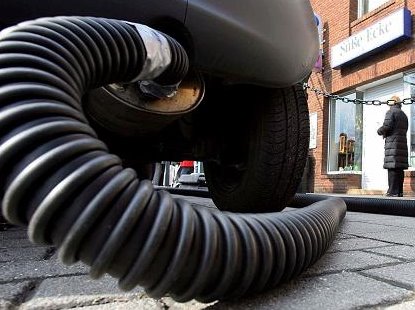



 "Using chance is like painting Nature - but which chance event, out of all the countless possibilities?"

