(via)
Technorati:
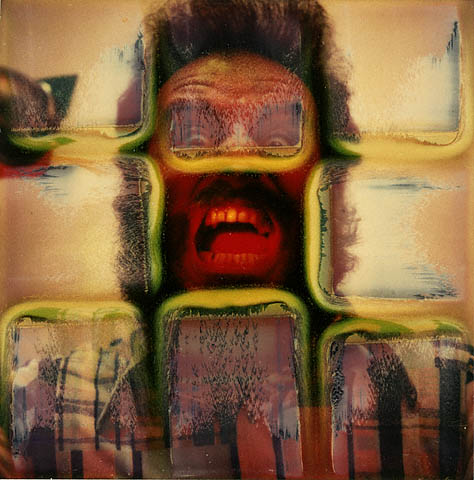
 Tadeusz Kantor, Panoramic Sea Happening (1967)
From the time of Verdun, Voltaire's Cabaret and Marcel Duchamp's Water-Closet, when the 'status of art' was drowned out by the roar of Fat Bertha - DECISION became the only remaining human possibility, the reliance on something that was or is unthinkable, functioning as the first stimulant of creativity, conditioning and defining art. Lately thousands of mediocre individuals ahve been making decisions, without scruples or any hesitation whatever. We are witnesses of the banalization and conventionalization of decision. This once dangerous path has become a comfortable freeway with improved safety measures and information. Guides, maps, orientation tables, directional signs, signals, centres, Art Co-operatives guarantee the excellence of the functioning of creativity. We are witnesses of the GENERAL MOVEMENT of artist-commandos, street fighters, artist-mediators, artist-mailmen, epistologs, pedlars, street magicians, proprietors of Offices and Agencies. Movements on this already official freeway, which threatens with a flood of graphomania and deeds of minimal significance, increases with each passing day. It is necessary to leave it as quickly as possible. This is not easily done. Particularly at the apogee of the UNIVERSAL AVANT-GARDE - blind and favoured with the highest prestige of the INTELLECT, which protects both the wise and the stupid.- Tadeusz Kantor (1915-90), a great, wonderful Polish artist, creator of the Theater of Death (the theater (or rather: performance) group he founded in 1955 was called Cricot2). Beyond being an excellent theater director and visual artist, Kantor was an eternal provocateur. His biographies are full of outrageous statements and controversial incidents.
 Kantor during the performance of his most famous play, Umarła Klasa (The Dead Class) (1975). You can see the director on the left, behind the bench, as he had the habit of "directing" (observing, but also slightly changing) the shows even during the performance.
 ["But you know - anyhow, i feel free!"]
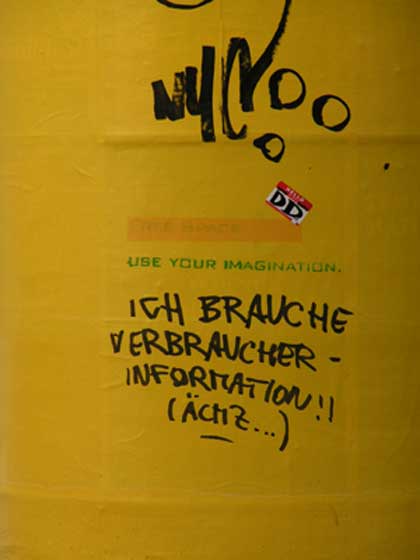 ["I need consumer information! (Argh!)"]
 ["Blue would have been nicer"]
 What's wrong with that?
 The work stayed on for two weeks. By week two, some storekeepers simply couldn't resist it:
 Bad? Well, many other people couldn't resist either:
 When London bids to participate in the (2012) Olympics, it means business. And culture. Which is why the bid comes accompanied by a wonderful program: 40 Artists, 40 days. Basically, it is a publicity for Britain and its artists:
In the final 40 days of the campaign we want to raise awareness of this wider Olympic opportunity, and encourage support for London 2012, by creating a unique countdown calendar that will focus attention on Britain’s exceptional creative talent. We have asked 40 leading artists to provide a work, either original video, music, text, performance or visual art, which will be showcased here on Tate Online as a message of Olympic support, with a new piece being added every day until you can enjoy all 40.The diversity is fantastic, as is the quality and the nearly always contemporary edge. On the site you'll find excerpts of dances (some quite interesting) , music, literature about music in England, and much, much more. My big disappointment was the work One Story Building by Blast Theory (you know I like them). But not because it's bad. It's an "interactive work" where you call a number and have to answer a series of 2000 (2012?) questions:
In this interactive work, the participant drills through two thousand either/or questions. Starting with the question ‘Urban or Rural?’, the piece moves from the expansive into the cloistered, finally arriving at a secret and private space. Reminiscent of ‘10×10’ by Charles and Ray Eames, it uses this swoop in scale to explore the taste of the participant, whilst gently mocking the notion of interactivity itself.And I can't even tell you what's it like - it's a number I can't access from Lisbon. Anyone in Britain can give some feedback (wink at Lunettes Rouges)?Single Story Building can be accessed anytime of day by phoning 0871 504 3987. Use your phone's keypad to navigate through the work. Calls are charged at the national rate (8p/min from a landline).